

A specialty retailer decides to sell online. The brief writes itself: get the catalogue in, wire up payments, switch on shipping, launch. Six months later the store technically works. It converts worse than anyone expected, and nobody can point at the reason.
We have seen this often enough to name it. We call it the counter problem, and it is the subject of our whitepaper on digitising expertise-led retail.
The diagnosis is not that the store was built badly. It is that in a shop whose competitive advantage is human judgement, one member of staff was quietly performing eight commercial jobs at the same time — and an ecommerce platform replaces exactly one of them.
The Eight Jobs Nobody Wrote Down
Stand behind a delicatessen counter for an afternoon and watch what actually happens. The person serving is:
Answering product questions. They are the product information layer. More usefully, they know which questions recur — which is almost never what the catalogue thinks is important.
Recommending. “You’ll want bread with that.” A contextual upsell, unprompted, that no category page performs.
Taking the standing order. “Same again next month?” Replenishment, handled by memory.
Honouring the gift card. The one sold over the counter last Christmas, redeemable because it is the same shop and the same till.
Directing people. Which branch has it, and when that branch is open.
Pointing out today’s offer. One thing. Selectively. Not everything at once.
Reassuring on safety. The allergy question, answered by someone accountable for the answer.
Setting the tone. The lighting, the counter, the restraint. Positioning performed as atmosphere rather than stated as a claim.
These jobs are invisible in a requirements document for precisely the reason they were cheap to run: nobody ever wrote them down. They were never a feature. They were a person.
A store missing four of these eight still passes user acceptance testing. It just converts worse than the shop it replaced, for reasons nobody can point at.
Why “Just Build a Webshop” Underdelivers
Buying a platform is correct, necessary, and roughly a third of the work. The reason it disappoints is a category error: teams treat digitisation as a transaction problem when it is a knowledge-transfer problem.
A platform gives you a cart, a payment gateway and a shipping table. It does not give you the person who used to stand behind the counter, and in an expertise-led shop that person was carrying most of the commercial load.
The cost of staying manual, meanwhile, is well documented. Order processing handled by phone, email or form runs at $30–80 per order in labour, error correction and cycle time, against $1–5 for an order arriving through an integrated system. Manual entry carries error rates of 8–15%. We unpack that arithmetic — and why it is usually invisible on a P&L — in the real cost of a manual order form.
The Method: Inventory the Counter, Then Rebuild It
The method is unglamorous and it works. Before writing a single requirement, list what the humans were doing. Then, for each item, name the interface that will carry that job instead. If you cannot name one, you have found a gap that will surface later as underperformance nobody can attribute.
| What the person did | What has to replace it |
|---|---|
| Answered product questions | Depth on the product page, weighted by which question actually recurs |
| Recommended what goes with it | Merchandising attached to intent, not to the catalogue |
| Took the standing order | Subscription or replenishment, with the saving made explicit |
| Honoured the card you sold them | One balance shared across every channel |
| Told you which branch, and when | Findability and routing, not a table of hours |
| Pointed out today’s offer | Conditional emphasis, not permanent noise |
| Set the tone of the room | Visual restraint used as positioning |
| Reassured on safety | The legal floor, plus a deliberate decision about how far above it to go |
Each row has a design discipline behind it, and each has become a piece of writing in its own right:
- The research question that fills in row one costs nothing and reorders roadmaps: ask what they phoned up about.
- Row two is the most underexploited surface in food and CPG retail: the recipe page is a storefront.
- Row three is the highest-value, least-contested revenue most specialty retailers have: solve replenishment before you chase new customers.
- Row four is where clean migrations discover they have an integration project attached: one card, two tills.
- Row six is a conversion-optimisation orthodoxy worth arguing with: emphasis that is always on is not emphasis.
- Row seven is a positioning decision disguised as a taste decision: why a gourmet store should look nothing like a supermarket.
The Evidence: A 1994 Oslo Delicatessen
The framework is not retrofitted. It came out of a project.
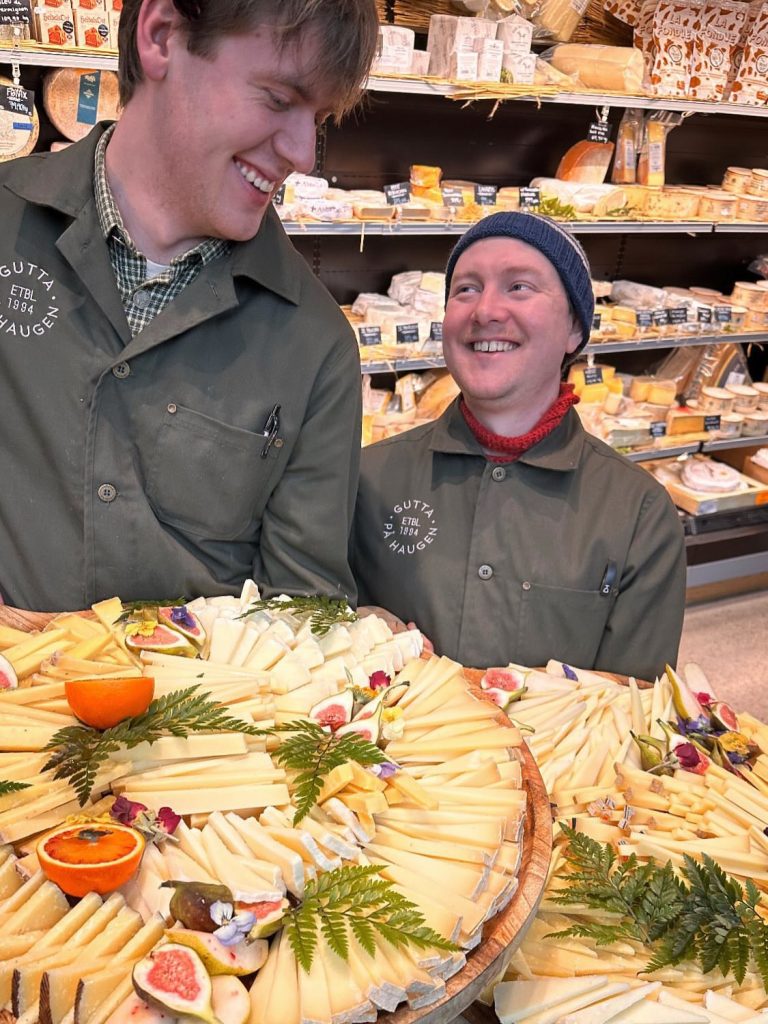
Gutta på Haugen is a specialty food shop in Oslo. It opened in 1994, runs several branches in the city, and ships nationally. Its reputation rests on a range that is genuinely hard to source. Until recently, its website was a form.
A customer described what they wanted. An employee read the form, telephoned them back, took the order verbally, arranged payment offline, and shipped the groceries. Every single order consumed a member of staff. The catalogue, in the words of the designer who replaced it, was:
“A generic page with no design and products listed like a word document.”
Asked which decision mattered most across the whole project, the same designer did not say “the checkout.” He said:
“Moving from phone orders to a proper WooCommerce store.”
Note the framing. Not building a cart — moving from phone orders. The operating model, of which the other seven jobs are the substance.
What that looked like in practice is documented screen by screen in the design case study, and the commercial picture that followed sits in the results: 6.8M+ NOK in ecommerce revenue at 4.24x blended ROAS across Meta and Google, 3.1x year-over-year revenue growth, and 2,967 conversions. Those figures come from Kilowott project reporting rather than from a platform export we can hand you — a distinction we keep making because it matters, and one we return to in measure the process you are about to delete. The paid-media structure behind them is broken down in what 4.24x blended ROAS actually looks like.
What This Costs You To Try
The uncomfortable part of the counter problem is how cheap the diagnosis is. You do not need a research programme. You need an afternoon with the people who answered the phone, a list of the jobs they were doing, and the discipline to name an interface for each one before the build starts.
The expensive version is the one where you skip that, launch a store that works, and spend the following year running tests on a checkout that was never the problem.
If your shop’s advantage is that your staff know things, then digitisation is not a platform decision. It is a question of how much of what they know survives the transition — and that is answerable, in advance, on paper.
Start with the whitepaper, or with the row of the table that describes your worst month.