

There is a particular kind of website that looks harmless. A page with a few product names on it, and a form at the bottom: tell us what you need and we’ll get back to you.
It is not harmless. It is the most expensive way to sell anything.
Where the Money Actually Goes
The published range for an order processed manually — by phone, email or a web form that generates an email — is $30–80 per order once you count labour, error correction and cycle time. The same order arriving through an integrated system runs at $1–5.
That gap is not efficiency theatre. It is made of four specific things.
Staff time per order. Someone reads the enquiry, works out what the customer actually meant, phones them, confirms items and quantities, takes payment details verbally, then keys the whole thing in somewhere. Ten to twenty minutes is normal for a catalogue with any complexity in it. Customer-facing teams in manual environments routinely spend 40–60% of their working time on order administration rather than on selling.
Errors. Manual entry carries error rates of 8–15% in typical environments — wrong item, wrong quantity, wrong price, wrong address. Each one becomes a phone call, a credit note, a re-ship, or a customer who does not come back. The cost of an error is always several times the cost of the original order.
Cycle time. The order does not exist until a human touches it. Nights, weekends, holidays and lunch breaks are all queue. In practice the customer waits hours to buy something they had already decided to buy.
The ceiling. This is the one that never makes it onto a spreadsheet. Manual processing has a hard throughput limit — whatever your staff can phone through in a day. On your busiest week of the year, that limit binds. Christmas demand does not queue politely; it leaves.
The first three costs show up as overhead. The fourth shows up as flat revenue in your best season, which is the last place anyone looks for a process problem.
Why It Stays Invisible
Manual order handling is expensive in a way accounting is structurally bad at seeing. There is no line item called “order processing.” The cost is smeared across salaries that would exist anyway, and the losses are counterfactual — the enquiry that never converted, the basket that was smaller than it would have been, the customer who bought once and drifted.
Compare that to the visibility of an ecommerce project, where every krone is a purchase order somebody has to defend. The status quo is free on paper and the fix has an invoice attached. That asymmetry is why the form survives for years after everyone involved has agreed it should go.
The Categories Where This Persists Longest
There is a pattern to which businesses still run on forms and phone calls, and it is not the one you would guess. It is not the least sophisticated operators. It is the ones whose advantage is human expertise — delicatessens, wine merchants, cheesemongers, butchers, specialist hardware, garden centres — because in those shops the phone call was genuinely doing useful work. We wrote about that at length in the counter problem.
The market data says the same thing from the other direction. In Norway, online grocery reached only 5–10% of its category in 2025, against 10–15% for e-commerce overall. Strong, trusted physical retail reduces the pressure to move online, so the sectors where in-person expertise matters most have digitised slowest. The same category is now the fastest-growing segment of Norwegian e-commerce, at roughly 14.8% CAGR through 2030.
That combination — under-digitised and fast-growing — is the whole opportunity. A national audience that increasingly wants to buy this way, and comparatively few specialty competitors who have built for it properly.
What It Looks Like When Someone Fixes It
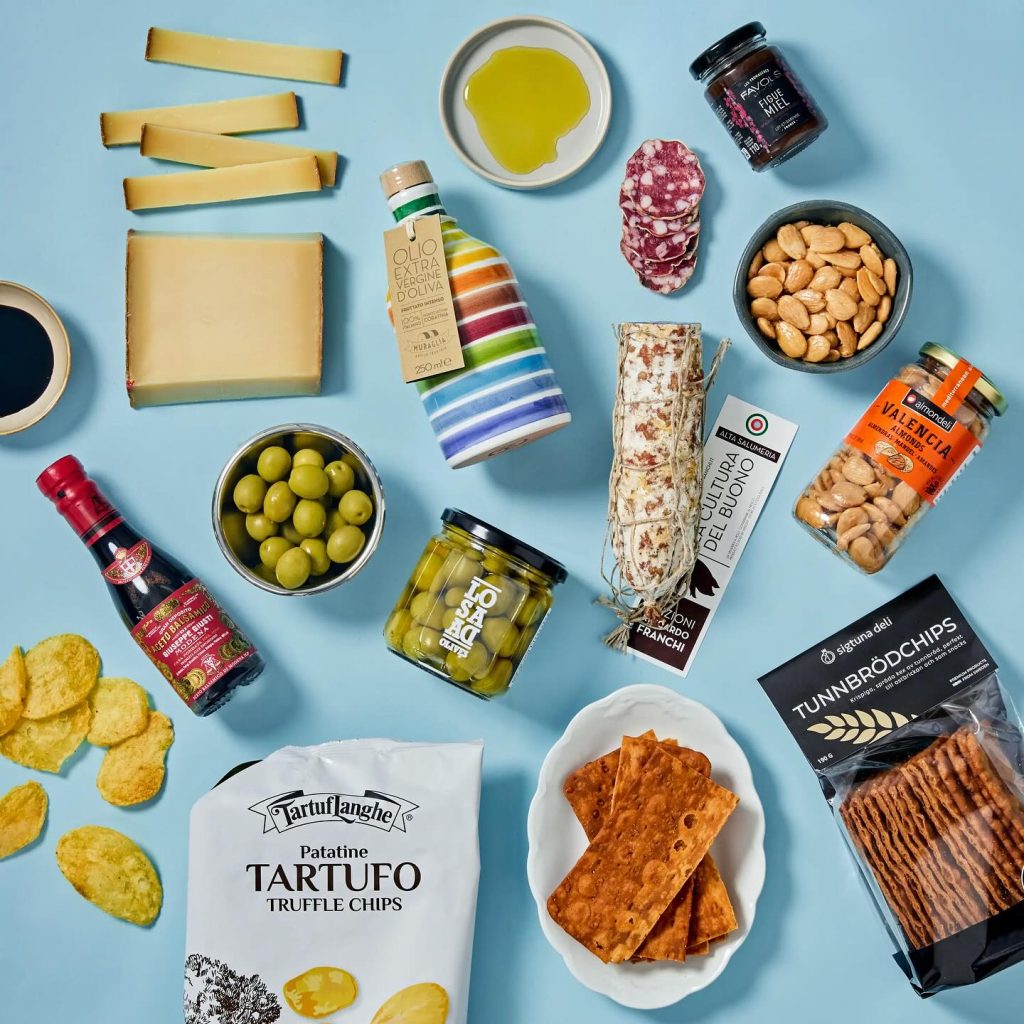
Gutta på Haugen is a specialty food shop in Oslo, trading since 1994, with several branches and a range that is hard to source anywhere else. Its website was a form.
The sequence was: customer describes what they want, employee reads it, employee telephones them back, purchase completed verbally, payment taken offline, groceries shipped. Every order consumed a member of staff. The catalogue itself, in the designer’s words, was “products listed like a word document.”
Asked what the pain point was, the client’s answer was one word: slow.
And asked why WooCommerce, the designer’s answer was equally short:
“The pain point was that it was slow and the solution of going with a WooCommerce site was a no brainer.”
The full reasoning, screen by screen, is in the design case study. Where it got to commercially is in the results — 6.8M+ NOK in ecommerce revenue, 3.1x year-over-year growth, 2,967 conversions, per Kilowott project reporting.
One honest caveat, and it is the most useful thing in this article. We cannot tell you what the manual loop cost Gutta specifically. Asked how many orders a day the phone process could handle, or what it consumed in staff time, the answer was: “I don’t have insights on that.” The old process is gone, so that number can never be recovered. The $30–80 figure above is market data, not this project’s result, and we are not going to blur the two.
The Cheapest Week of Work in the Project
If you are running any part of your sales through a form, a phone or an inbox, there is one piece of work worth doing before anything else — and it costs a week, not a budget.
Measure the process you are about to replace:
- Orders per day, and what happens to that number in your peak season
- Minutes per order, timed rather than estimated, from enquiry received to order entered
- Error and re-ship rate, counted for four weeks
- Enquiries that never converted, which is the number nobody has
- Time-to-response, average and worst case
That is your before-figure. It is the only work in the entire project that becomes permanently impossible the moment you launch, and it is the difference between a business case and a hunch. We make the argument properly in measure the process you are about to delete.
Two related pieces, if the cost framing is the part you needed: replenishment is the version of this problem that repeats every month, and the paid-media side of the same project shows what happens when demand generation finally has a store worth sending traffic to.
The form is not a small inefficiency. It is a per-order tax, a throughput ceiling and a response-time problem wearing the costume of a simple contact page. The good news is that it is the rare business problem where the arithmetic does the arguing for you — as soon as somebody writes it down.