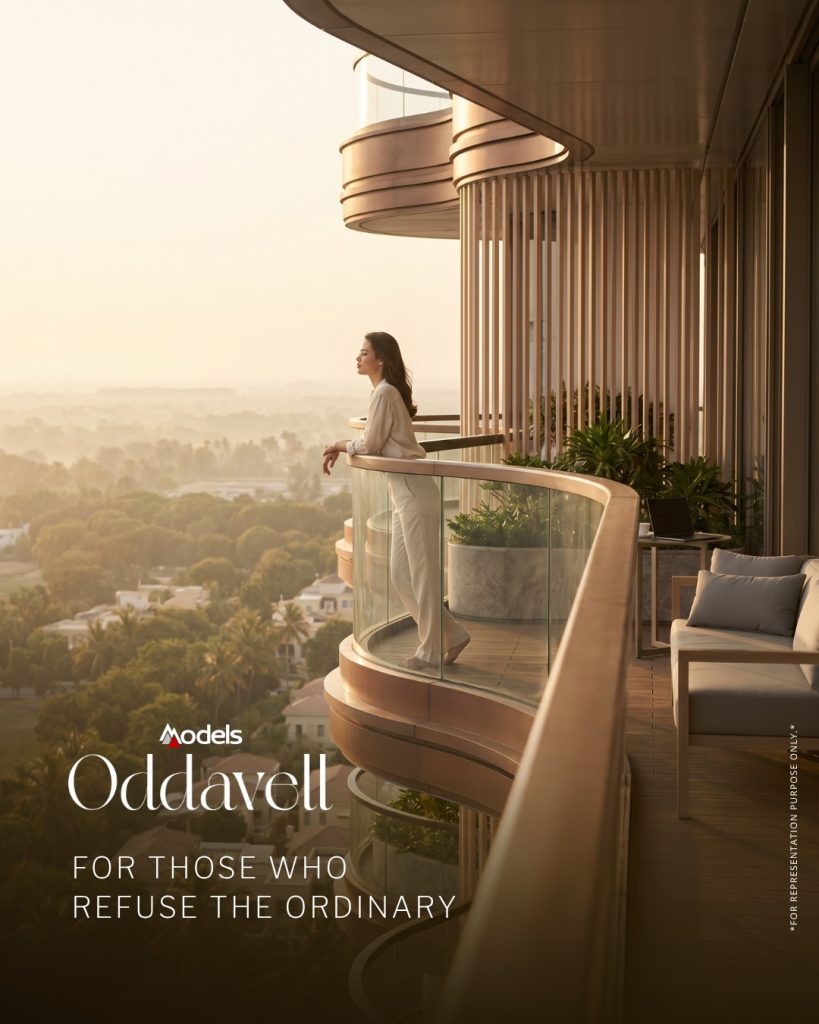


Load ten competing property pages and count how far you have to scroll before location gets more than a passing mention. On most of them, it’s a long way. The hero is a render, the second section is amenities, the third is floor plans, and somewhere past the fold — sometimes not at all — there’s a line about the neighbourhood. The page is built as if the building is the scarce thing and the address is a footnote.
That’s backwards, and once you say it out loud it’s obvious why: any competitor with enough capital can build a comparable pool, a comparable gym, a comparable concierge desk. Nobody can build your address. If amenities are reproducible and location isn’t, the page should be sequenced to lead with the thing nobody else can copy — which is the third principle in the one-feature framework, and the one that has nothing to do with visual design at all. It’s purely about order.
What “sequence by scarcity” looked like on a real page
Models Oddavell’s landing page runs to 7,838 pixels across twelve sections. The heritage and location content — the story of the hill the building sits on, the noblewoman who shaped its history, the land’s identity from before it was called Dona Paula — lands early, well before any amenity, specification, or floor plan appears. The reasoning behind that placement, in the designer’s own words, is close to a one-line summary of the whole principle:
“The location matters. Dona Paula is one of the most desired locations in Goa today. Amenities can be found elsewhere but the location is rare.”
That’s not a marketing flourish — it’s a comparison a buyer is already going to run whether the page helps them or not. Anyone shopping in the ultra-luxury tier is looking at several projects in the same category, and if the first thing every page shows them is a features list, they’re being handed a spec sheet to compare, feature by feature, against every other spec sheet in their browser tabs. That’s a comparison built entirely on ground where the project has no structural advantage — because features, by definition, are the things a well-funded competitor can eventually match.
Leading with the address changes the terms of the comparison. There’s no substitute for a specific hill, a specific stretch of coastline, a specific fifteen-minute drive to a specific city centre. A buyer can prefer another project’s amenities. They cannot acquire this project’s location by choosing someone else.
Why this connects back to finding the feature in the first place
This principle isn’t unrelated to the feature-finding work that opens the framework — it’s largely the same discipline, applied to information architecture instead of shape. Finding a genuine distinctive feature usually means looking past the category’s usual answers (marble, gold, skyline shots) toward what’s actually specific to the asset. Sequencing by scarcity is the same search, run against the page outline instead of the moodboard: what’s on this page that’s genuinely irreplaceable, and is it actually leading, or is it buried under three sections of things any competitor could also claim?
Run that audit on your own page or deck and the answer is often uncomfortable, because features are simply easier to write about. A pool has a clean, bounded description. A location’s value is diffuse — it’s partly the view, partly the neighbourhood, partly a kind of prestige-by-association that’s hard to compress into a bullet point. That difficulty is exactly why so many pages default to leading with features: not because features matter more, but because they’re easier to write a paragraph about on a deadline.
The limits of this argument, stated plainly
This is a design and information-architecture argument, not a performance claim. Nothing here should be read as “moving location up the page increases conversion” — that would be a number we don’t have, because the Oddavell site hasn’t launched and there’s no enquiry or engagement data to point to. What exists is client sign-off on the page order as built, and a piece of reasoning from the designer that holds up on its own logical merits, whether or not it eventually shows up in a metric. We treat that distinction as load-bearing rather than a formality — see what client approval does and doesn’t prove for the full argument on why “the client approved it” and “it works” are two different claims that shouldn’t get blurred together.
If and when a site like this does go live, page order is exactly the kind of decision worth testing rather than assuming — scroll depth to the heritage section, time spent there relative to the amenities section, whether enquiry submissions correlate with exposure to location content before amenity content. None of that data exists yet, but the plan for collecting it is worth having ready before launch, not improvised after — covered in what to measure on a luxury property site after it goes live.
Until then, the reasoning stands on its own: amenities are a commodity, and location isn’t. A page’s structure should say so before the buyer has to work it out for themselves.