

Fat Hamster Studio
Fat Hamster: from a 2D logo to a rig-ready 3D mascot in one day
We took Fat Hamster Studio’s 2023 mascot, a flat orange hamster in a logo, through every stage a traditional animation studio would: brief, pencil, watercolour, turnarounds, 3D modelling, texturing, lighting, animation, and three finished shorts. AI did the heavy lifting; our team made the calls.
- Client
- Fat Hamster Studio, part of Kilowott
- Time
- About 17 hours, 25–26 Nov 2026
- Traditional estimate
- ~560–720 hours
- Delivered
- Rig-ready 3D model and three finished shorts
Chapter 01 · Overview
Same steps. A fraction of the time.
We took our 2023 mascot, a flat orange hamster in a logo, through every stage a traditional animation studio would: brief, pencil sketches, watercolour, turnarounds, 3D modelling, texturing, lighting, animation, and finished shorts. At every step, AI did the heavy lifting and our team made the calls.
a typical small-studio schedule for the same work
Estimate, range 560–720 hours
our real time, dead ends included, several sessions in parallel
Worklog, 25 Nov 07:30 to 26 Nov 00:15
finished vertical shorts with voice and sound, plus a rig-ready 3D model
14.6 s, 24.8 s and 24.6 s
Higgsfield credits for everything
Credit log
Traditional times are our estimates for a small studio making one stylised 3D character and a 20-second short, based on common industry ranges and counted in working hours (an eight-hour day, a 40-hour week); real schedules vary and stages overlap. AI times come from our worklog timestamps and include the attempts that failed.
The team
Who did what
Creative direction
Aaron (Nordic Intent / Kilowott): every pick and every approval. One producer plus AI.
Claude Code sessions
Claude Opus 5.5, in parallel sessions: one for the character and the 3D model, one for the design-process art and the first skit, one for rigging and animation.
Tools
Blender 5.3, driven by Python scripts, headless. Higgsfield: Nano Banana Pro for images, Tripo H3.1 and Meshy for image-to-3D, Kling 3.0 for video, Wan 2.7 for lip sync. ffmpeg and ImageMagick.
Chapter 02 · Brief
Who is this hamster?
Every character starts with a brief: personality, backstory, voice, rules. Ours had to tie into the studio: born in Goa in 2018 alongside Fat Hamster Studio, moved to Norway with the second office, calls every artist part of “the horde”.
Traditionally
Workshops with the client, a writer drafting a character bible, a few rounds of edits. Usually 24–40 hours of work before anyone draws.
How we did it
Claude studied the 2023 logo and seven old GIF loops (scooter, phone call, swing, float, run, curious peek), then wrote a full character profile in one pass: personality, backstory, voice lines, do’s and don’ts, signature poses, expressions, and a palette. Aaron edited one rule: teeth are fine.
What worked: starting from our real 2D art kept everything on-brand from day one.
in a small studio, the traditional way
Estimate
with AI, our real time from the worklog
Worklog, 25–26 Nov 2026
The profile
What we wrote down
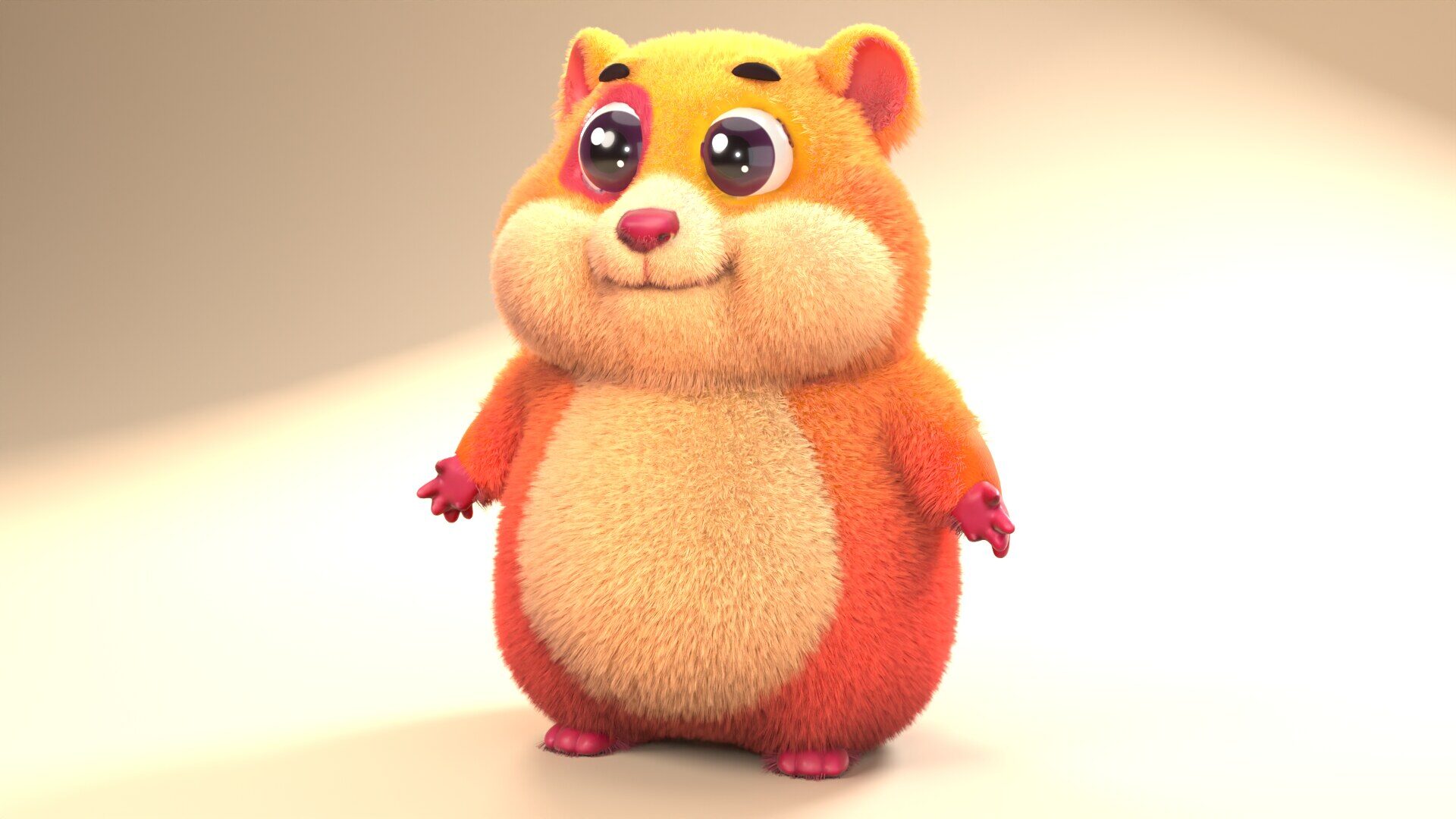
A round, golden-orange hamster with one berry-coloured eye patch, huge plum eyes and very short arms, who takes his snacks and his animation equally seriously.
Personality
The mascot and unofficial creative director of Fat Hamster Studio: the first face a client sees and the last one to sign off a shot.
Curious, warm, a little dramatic. He reacts with his whole body, because that is the studio’s craft: to emote. Easily distracted by something shiny or edible, then suddenly very focused. Never mean, never sarcastic.
Wants and flaws
He wants a perfect shot, a full cheek pouch, and the horde together.
He over-commits (“one more frame”), hoards snacks and reference images, and can’t sit still when someone says “render’s done”.
Backstory
Born in 2018 in a Goa studio between palm trees and the sea, the same year Fat Hamster Studio started as part of Kilowott. He got fat on cashews from the Goan hills and stayed up nights watching the artists draw, until a sketch of him came to life on screen.
When the studio opened its second home in Norway, he rode his blue scooter to the airport, discovered the fjords, snow and brown-cheese waffles, and now splits his year between monsoon and northern lights. “Two studios, one horde.”
Voice
Short, warm sentences. Excited, never shouty. Playful, never silly about the work. He talks about the horde as “we”, in feelings and motion words: “this shot needs more squash.” Now and then a Goan or Norwegian word: “Hei!”, “Bebinca break?”
“Give us a story. We’ll give it a heartbeat.”
Do
Keep him round: the silhouette (pear body, ears at the top corners, no neck) is the brand. The berry eye patch always sits on his right eye (the viewer’s left). Big eyes with a white highlight in the upper left, and small dark eyebrow dashes that carry most of the acting. Let him act with the body: lean, squash, stretch, cheek puff.
Don’t
No thin, sporty or realistic version, no visible neck, no long arms. No real anger, nothing scary, no weapons; teeth are fine, for example in a big laugh. Don’t move or mirror the eye patch, or change his colours beyond props and clothes (a scarf in Norway, sunglasses in Goa). Never use him to make fun of clients, competitors or other cultures.
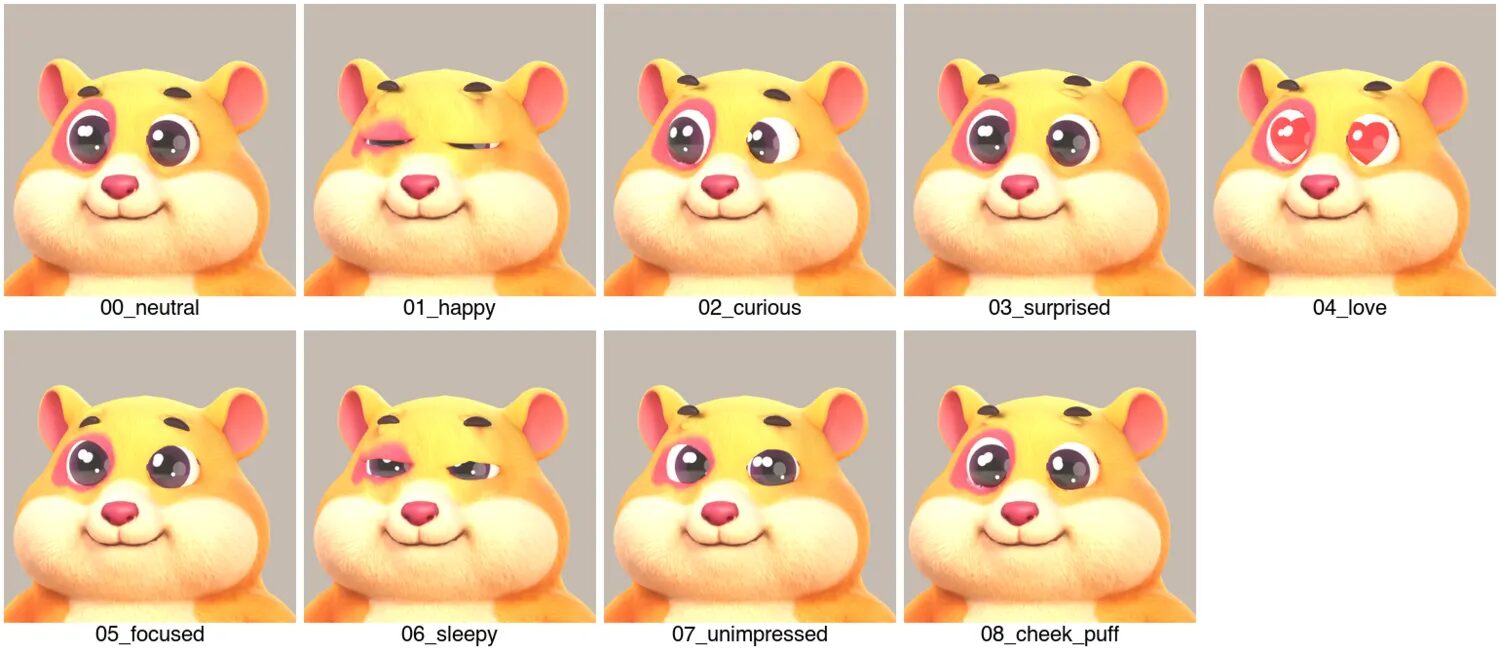
Signature poses: peek (the logo), curious lean, on the phone, scooter ride, float on a flamingo ring, swing with an ice lolly, run, and ta-da (new, for reveals). Expressions: neutral, happy, curious, surprised, love, focused, sleepy, unimpressed, and cheek puff.
Name: still open. The options are Kaju (“cashew” in Konkani and Hindi), Bolle (a Norwegian sweet bun), Bebinca or “Bebi” (Goa’s layered dessert), and Fatty Ham. Working title: “Hammie”.
Tools: Claude Code, the 2023 brand GIFs.
Chapter 03 · Sketches
Rough pencil: find the shape
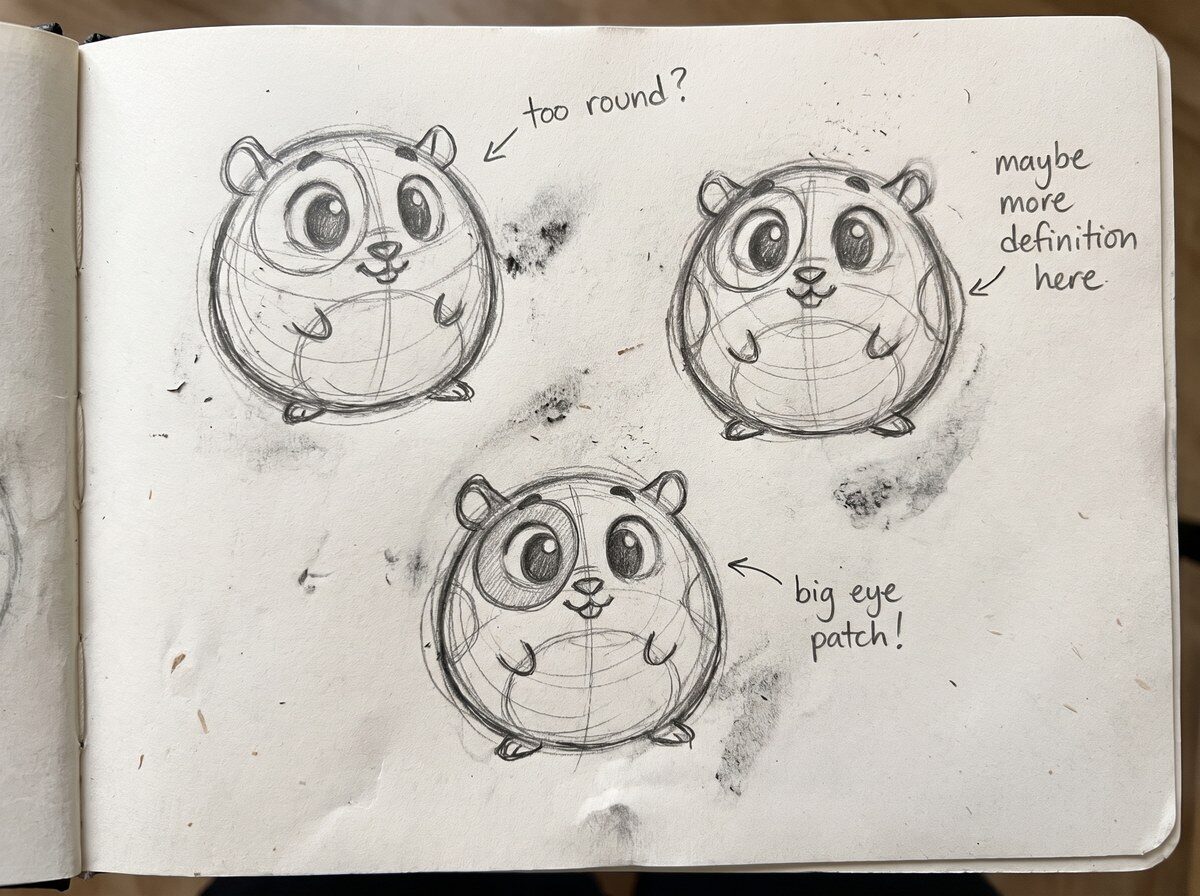
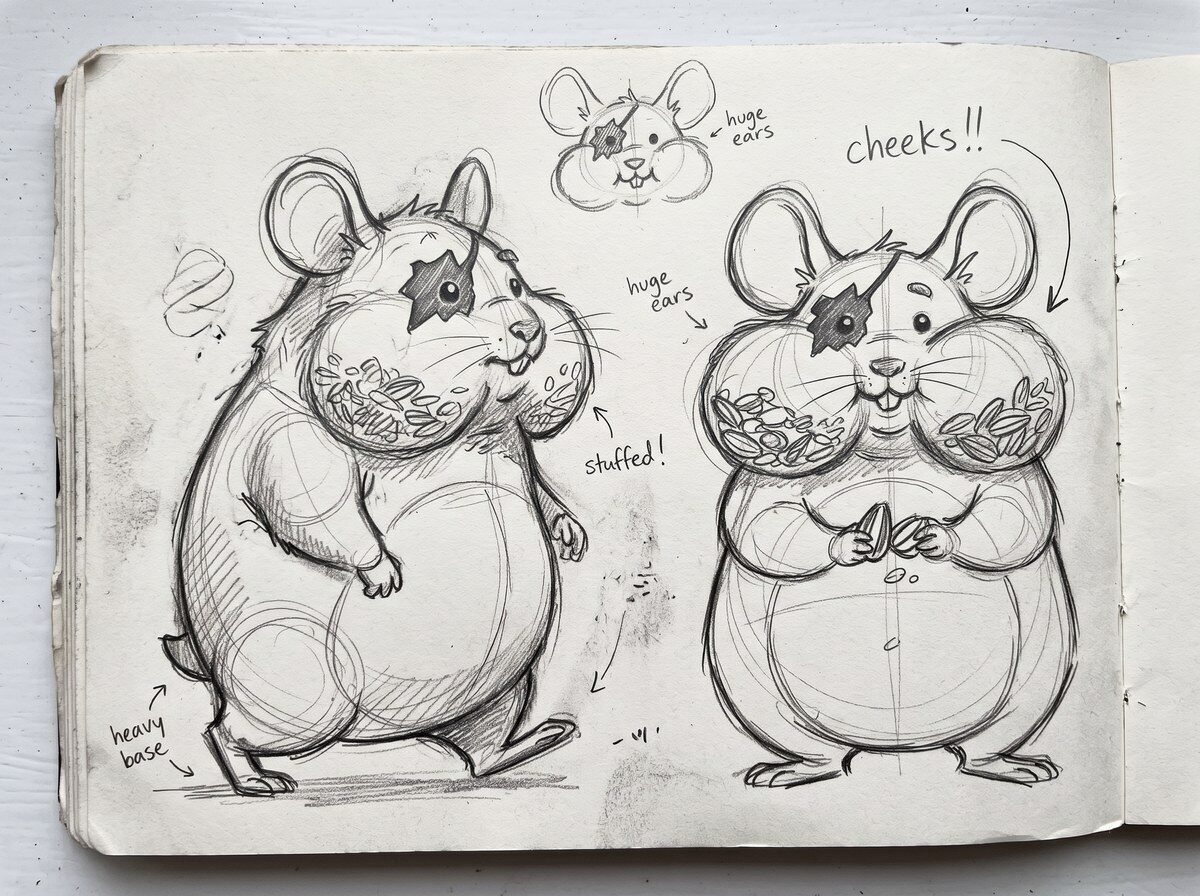
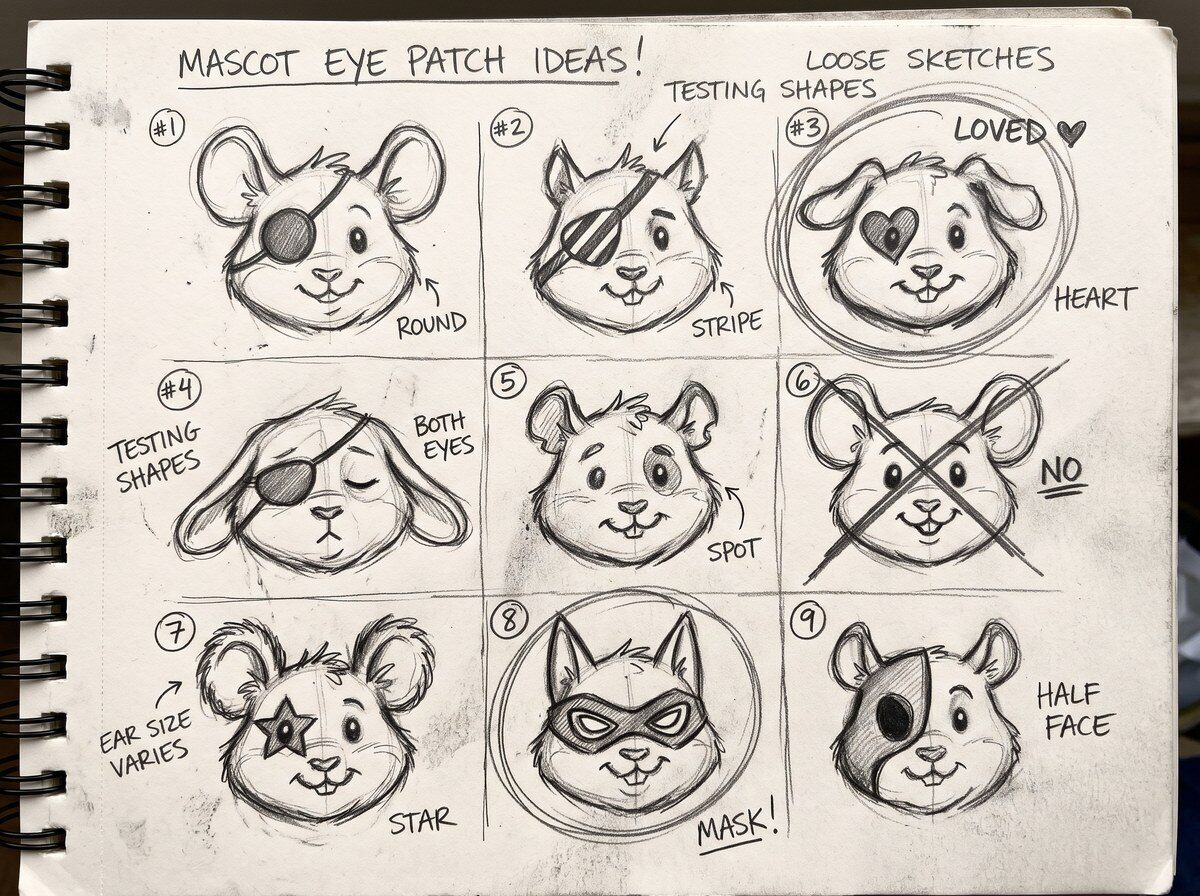
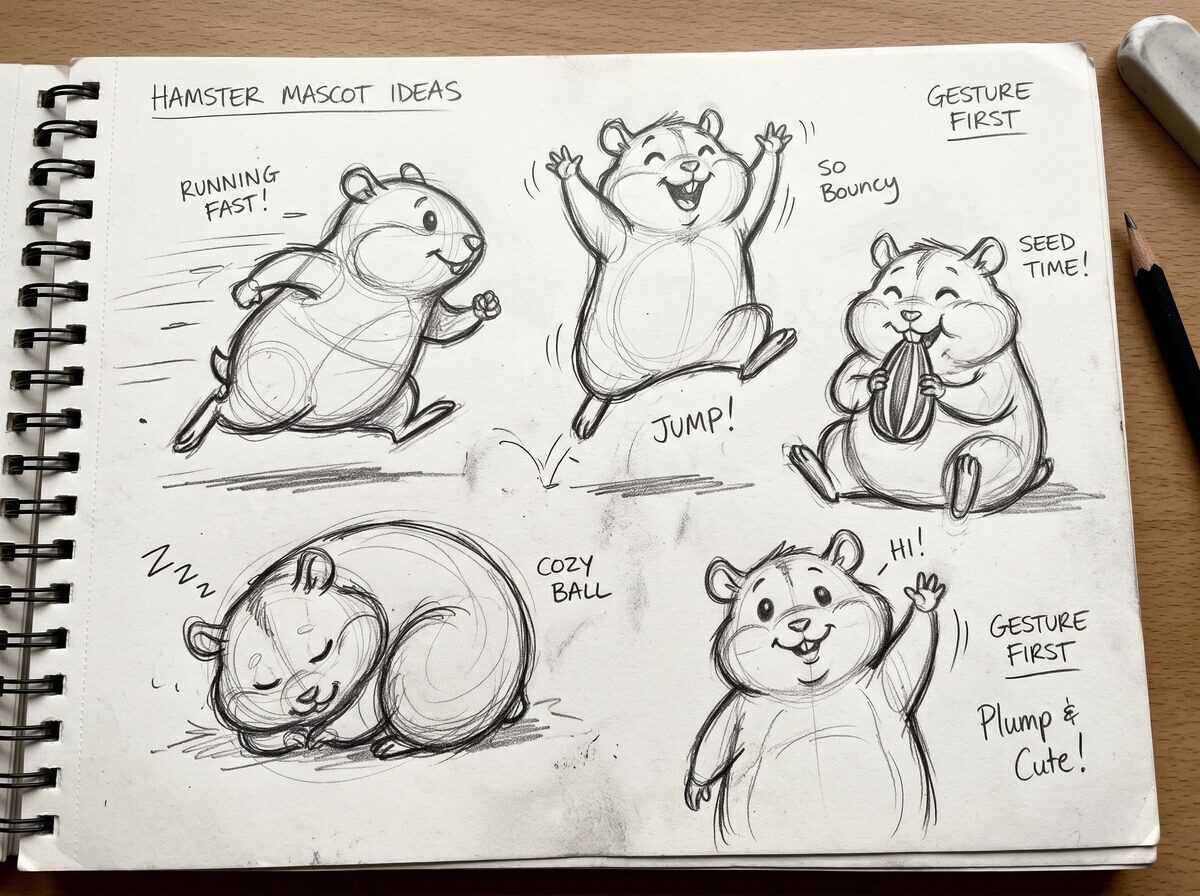
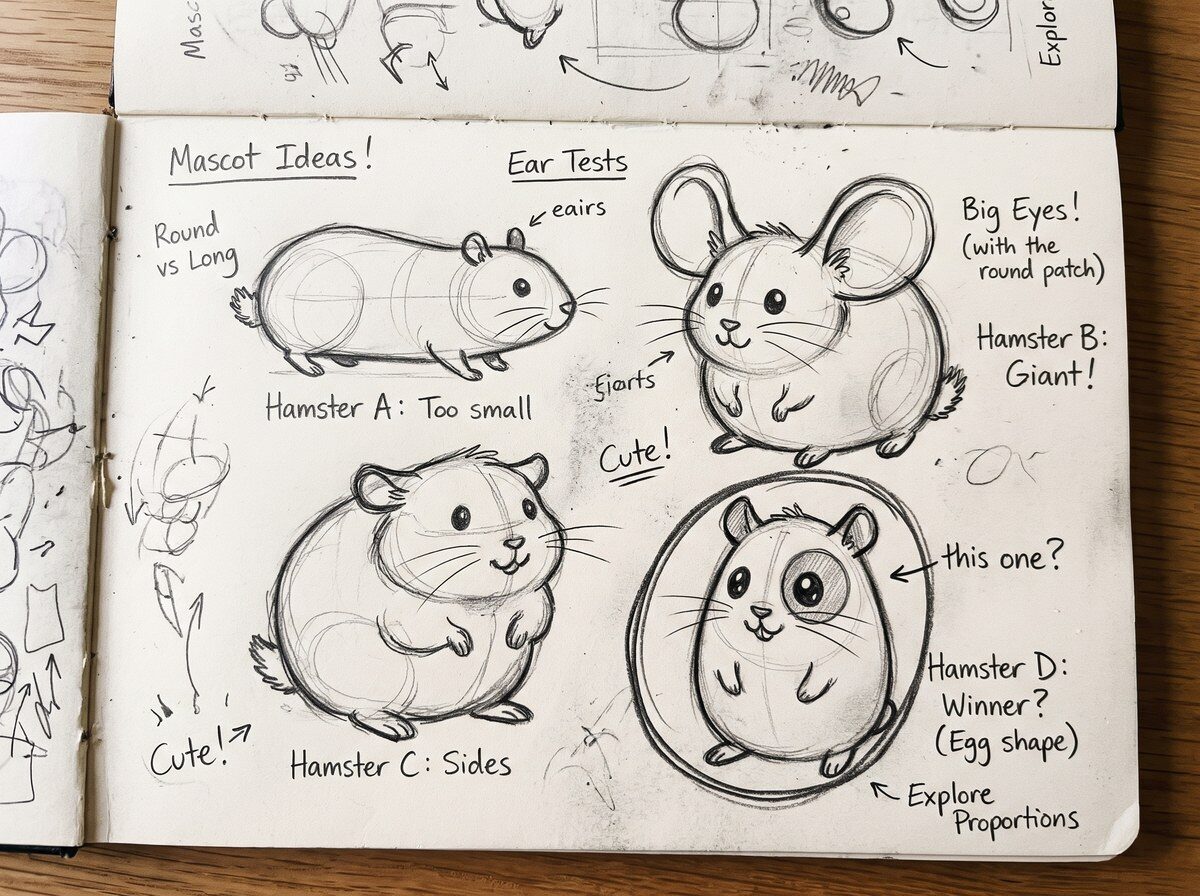
Thumbnails are where a character is found. Round or slim? How big are the ears? Where does the eye patch go? You draw dozens, circle the good ones, cross out the rest.
Traditionally
An artist fills sketchbook pages over 40–80 hours, with review rounds in between.
How we did it
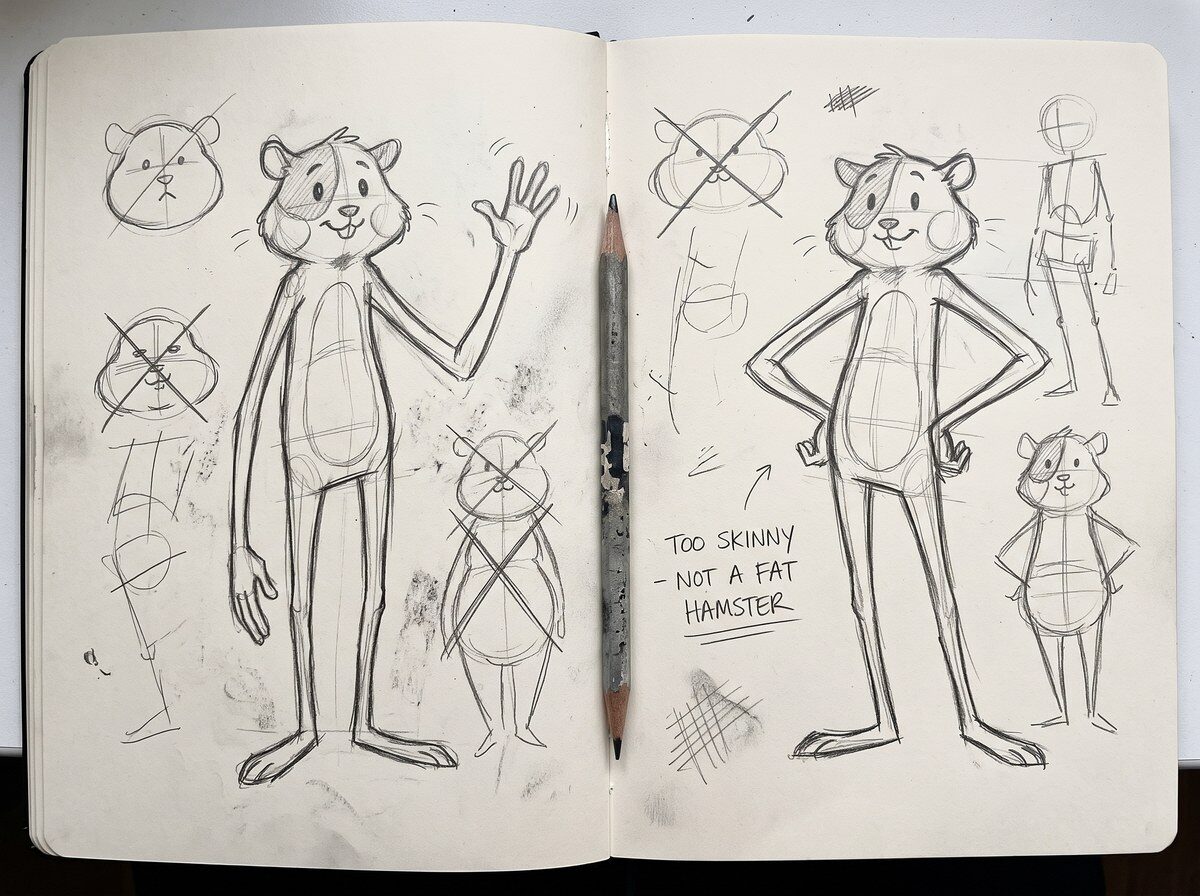
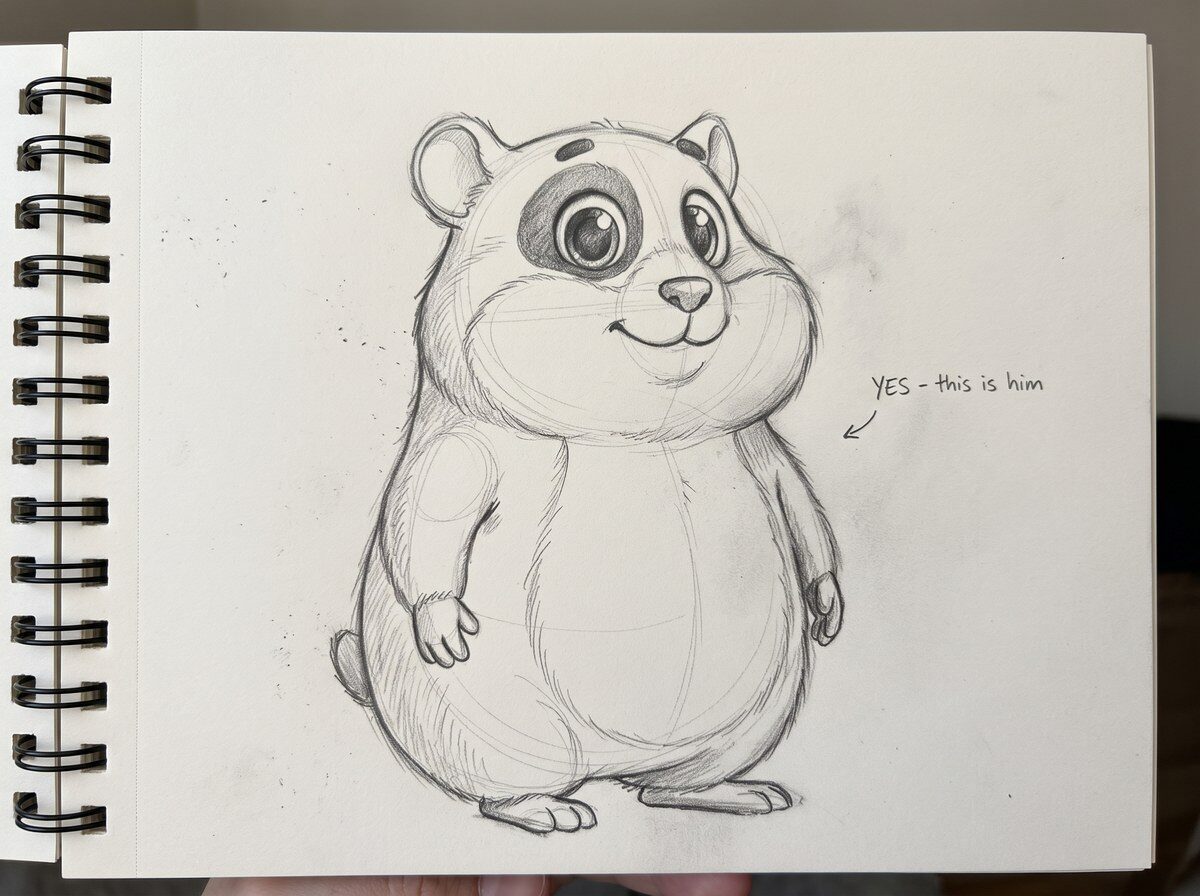
We generated a full exploration in pencil style: a very round take, a slim one, a chunky pear shape, nine eye-patch tests, gesture poses and ear studies, ending on a “yes, this is him” page.
What worked: seeing wrong options side by side made the right one obvious. The “too skinny” page settled the brief that he must be fat.
in a small studio, the traditional way
Estimate
with AI, our real time from the worklog
Worklog, 25–26 Nov 2026
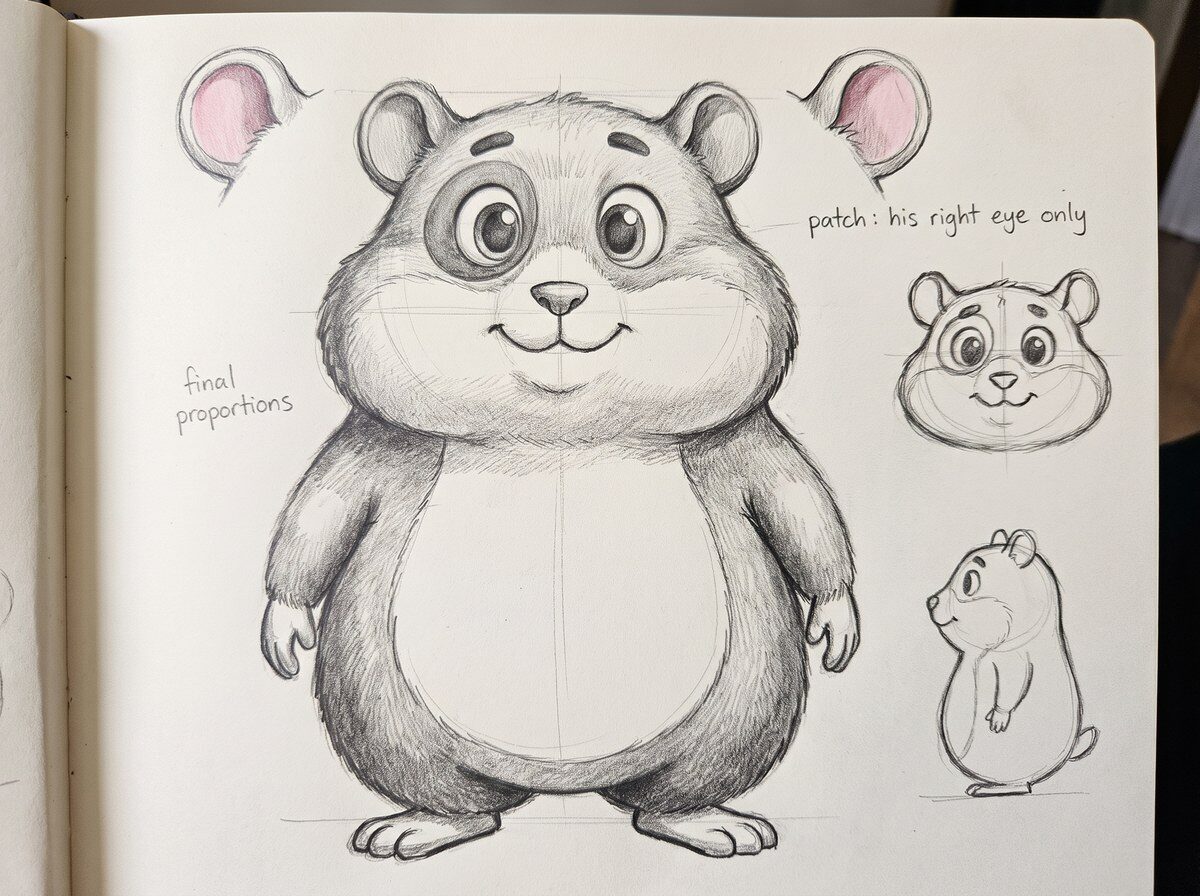
Tools: Higgsfield, Nano Banana Pro. About 16 credits.
Chapter 04 · Colour
Watercolour: find the palette
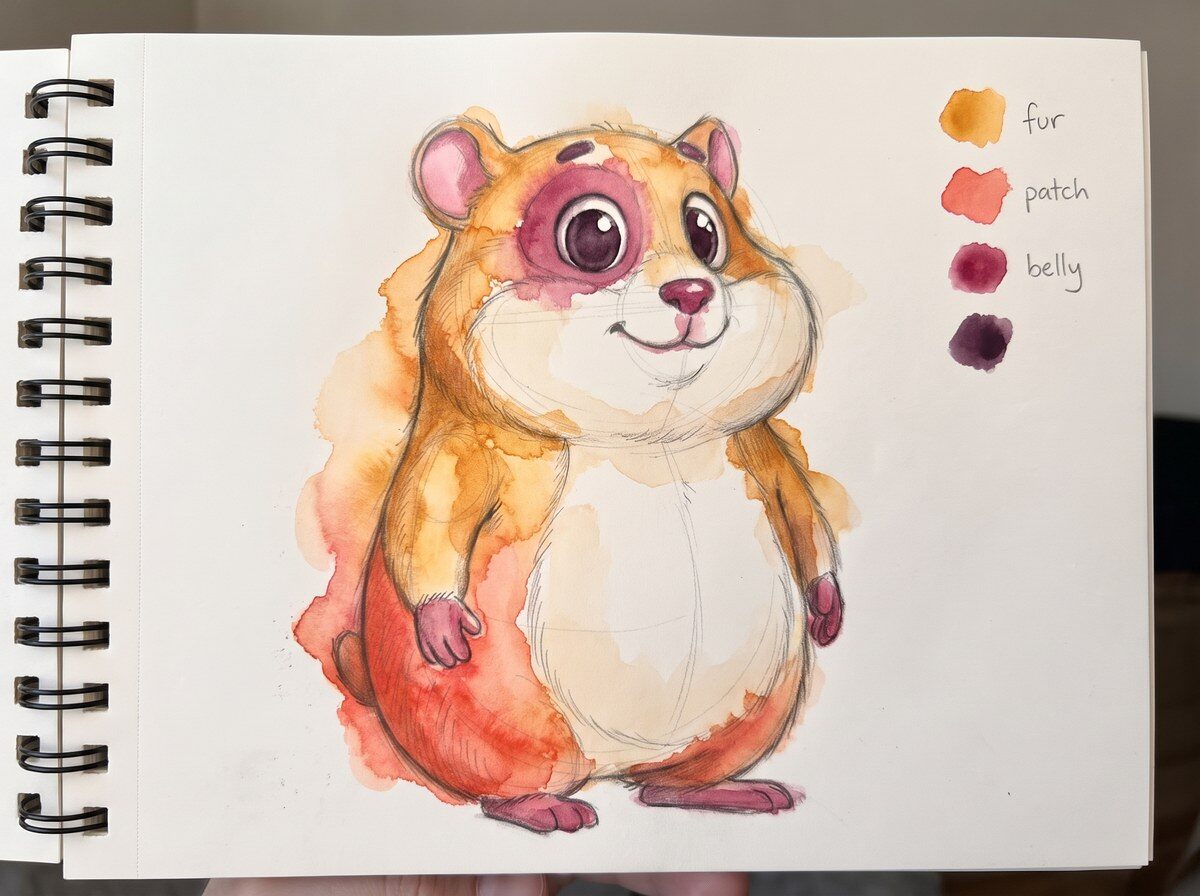
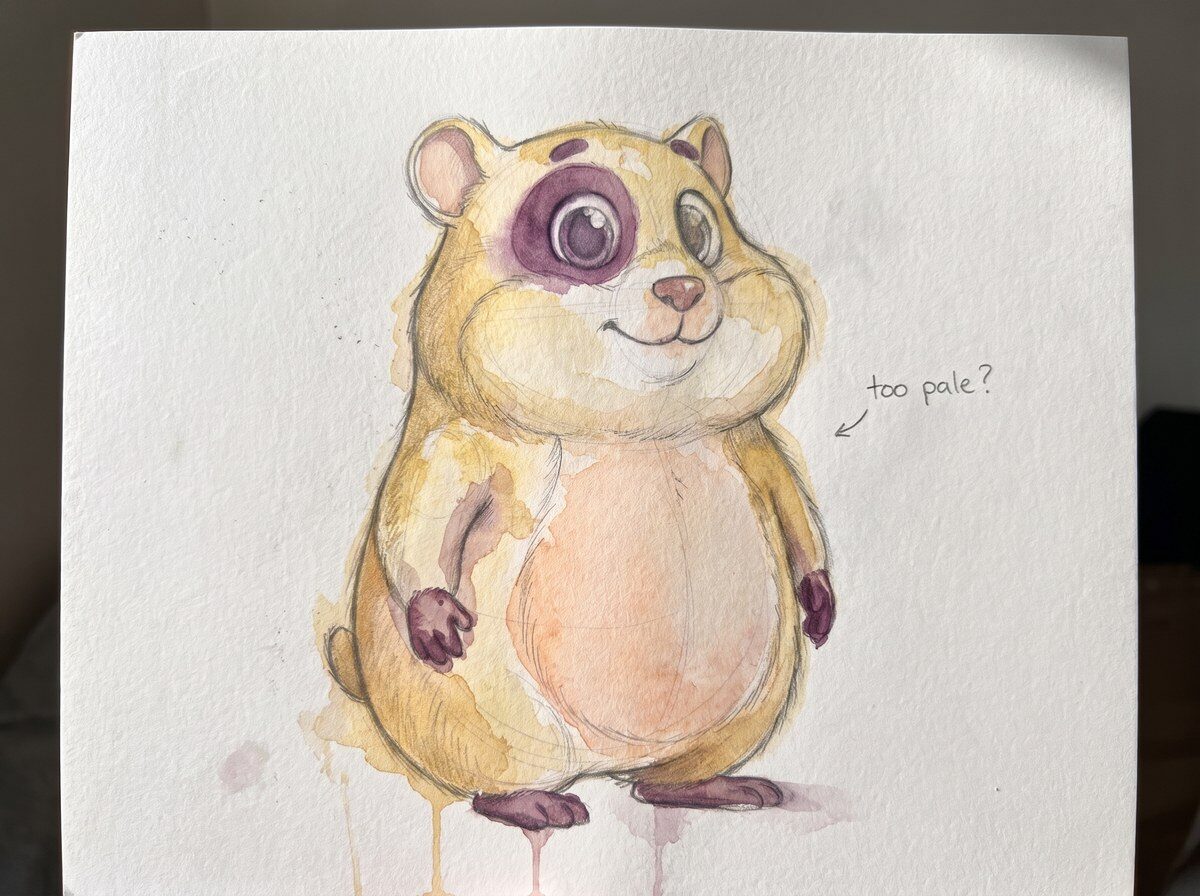
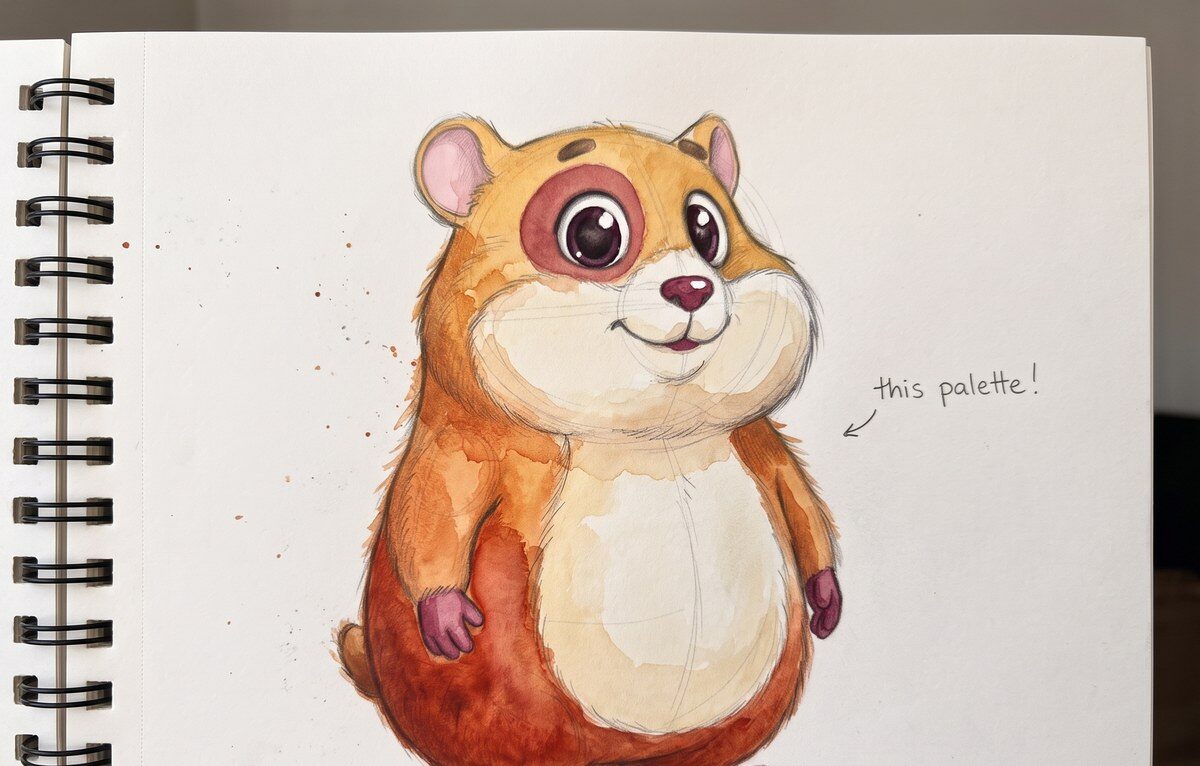
Loose colour over the chosen sketch tests the mood before anything gets locked: how golden, how orange, how strong the berry patch.
Traditionally
Several painted passes and client feedback: 24–40 hours.
How we did it
Three washes over the chosen sketch: a first try, a paler version, then the palette we kept. The kept colours became the hex values in the model sheet.
What didn’t: the pale yellow and soft plum read as washed out next to the brand orange. Dropped.
in a small studio, the traditional way
Estimate
with AI, our real time from the worklog
Worklog, 25–26 Nov 2026
Palette
The colours we kept
As used on the 3D model. Brand orange, ink and paper are for flat 2D use.
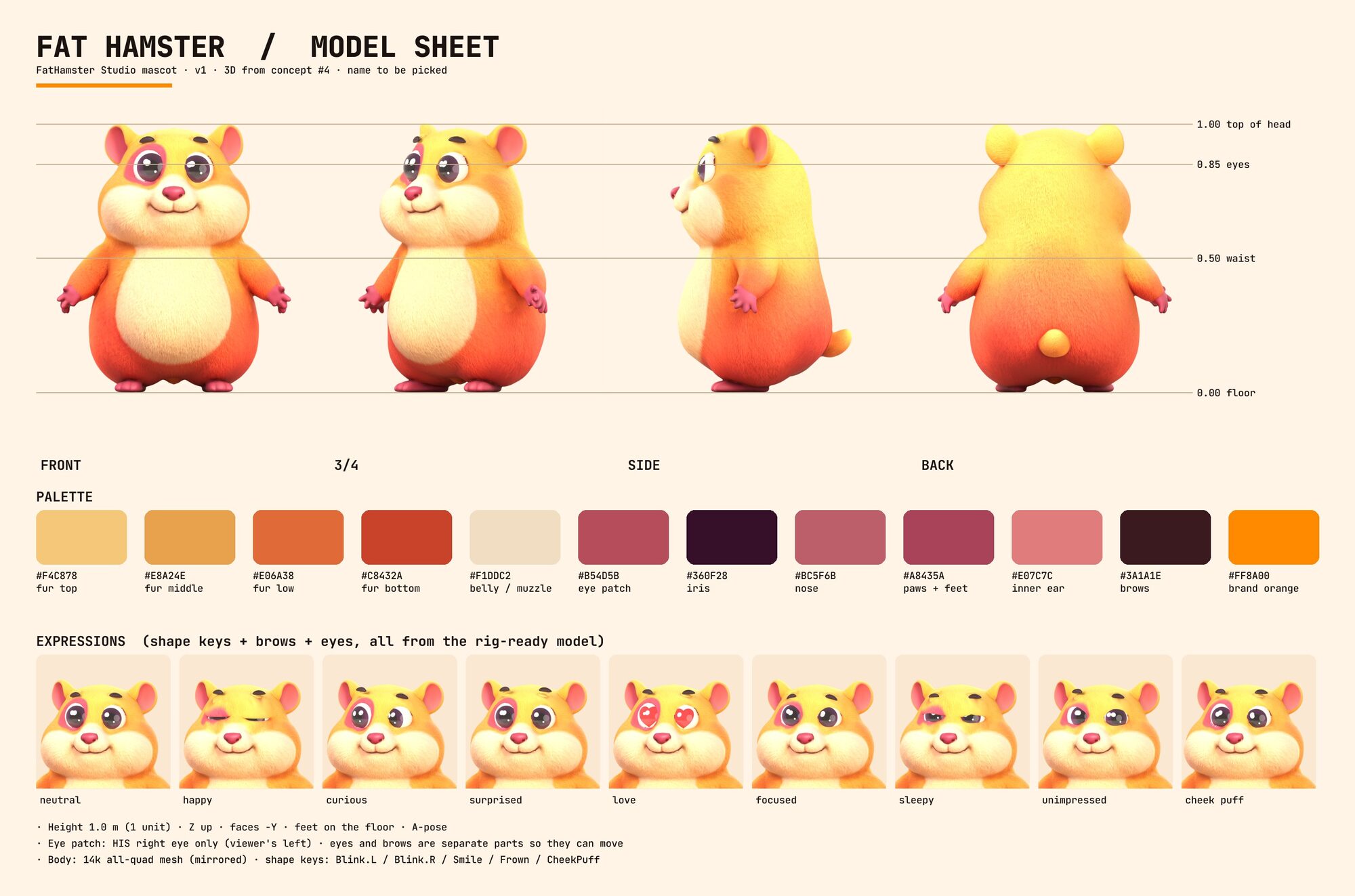
#F4C878#E8A24E#E06A38#C8432A#F1DDC2#B54D5BRound, on his right eye#360F28Rim #6E2F62, pupil #12050D#BC5F6B#A8435A#E07C7C#3A1A1E#FF8A00Flat use, 2D#1A13102D only#FFF4E6Tools: Higgsfield, Nano Banana Pro. About six credits.
Chapter 05 · Turnaround
Lock the design on paper
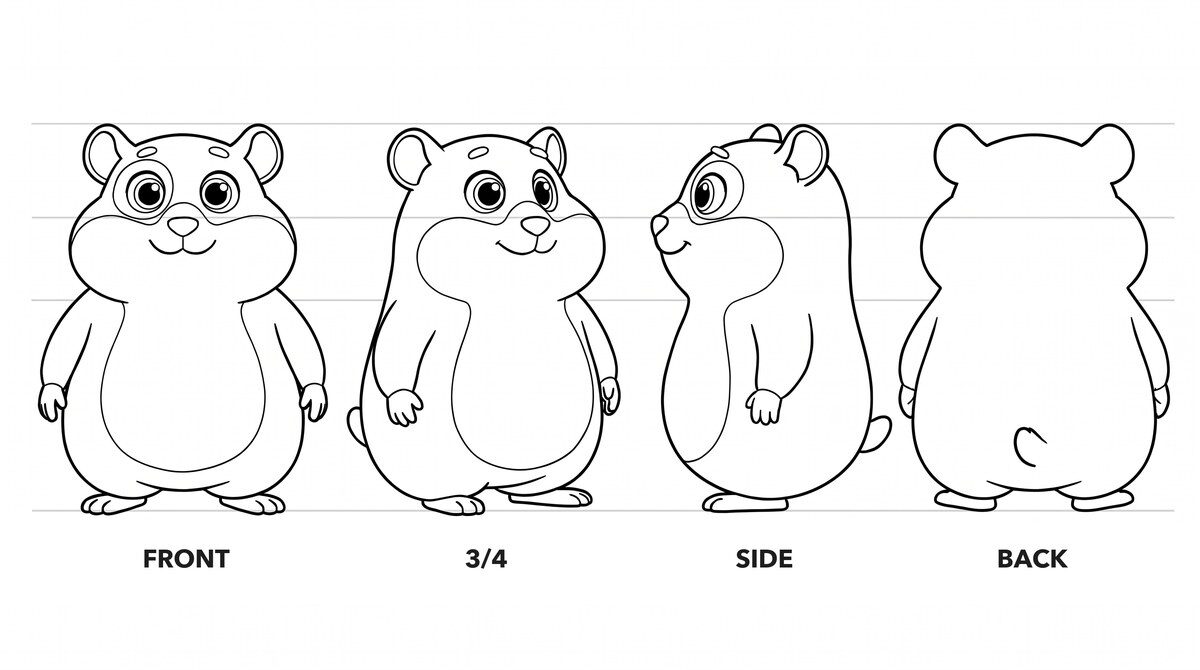
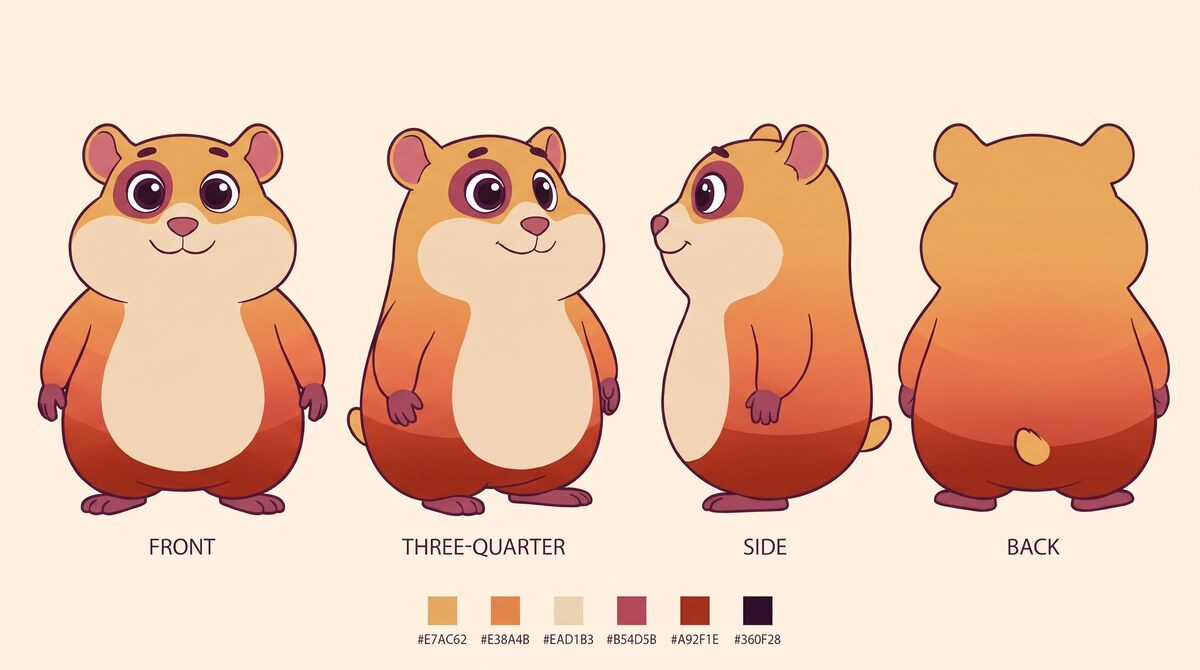
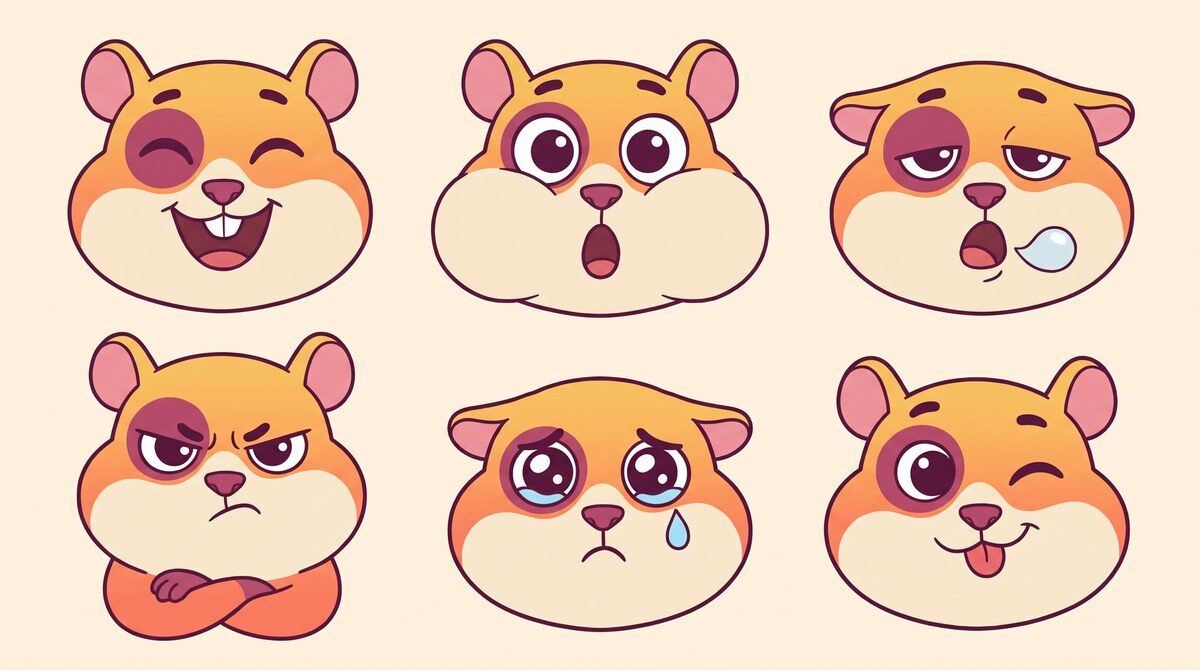
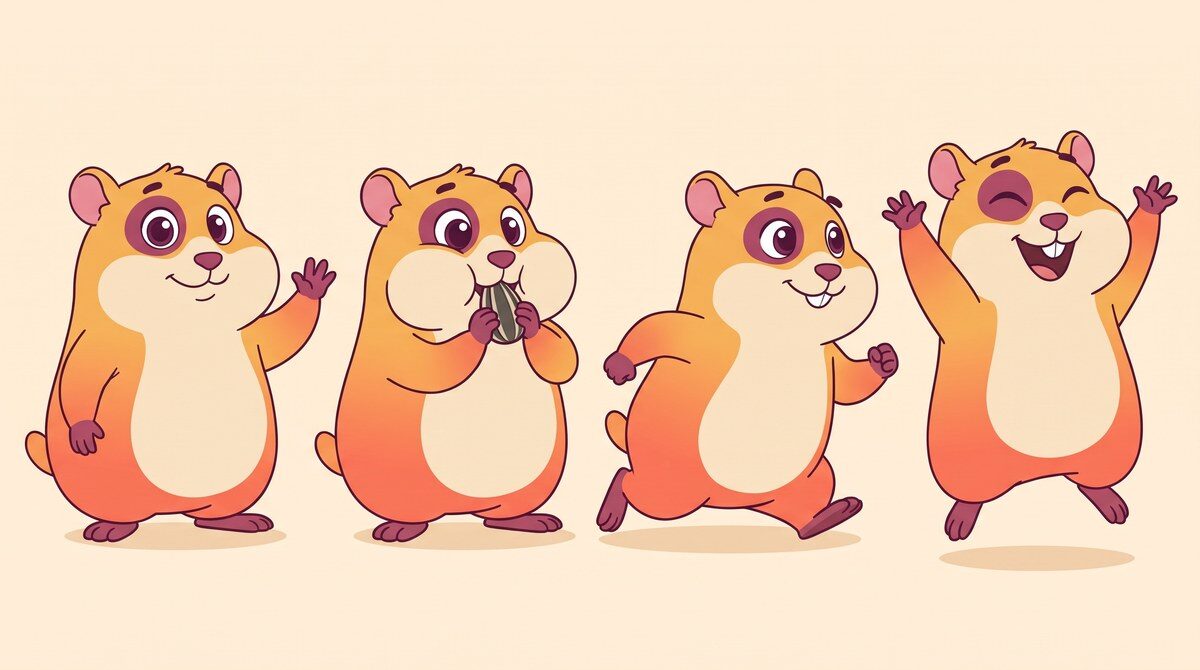
Before 3D, a studio cleans the design into line art, then a flat-colour turnaround (front, side, back) plus expression and pose sheets. This is the contract every artist after you works from.
Traditionally
A clean-up artist and a colourist: 40–80 hours for line art, turnaround, expressions and poses.
How we did it
Clean, single-weight ink line art, then a flat 2D colour turnaround, six expressions and four poses. Where the AI drew the side view the wrong way round, we mirrored it in code so the patch stays on his right eye.
What worked: fixing one rule early (patch on his right eye only) saved errors in every later stage.
in a small studio, the traditional way
Estimate
with AI, our real time from the worklog
Worklog, 25–26 Nov 2026
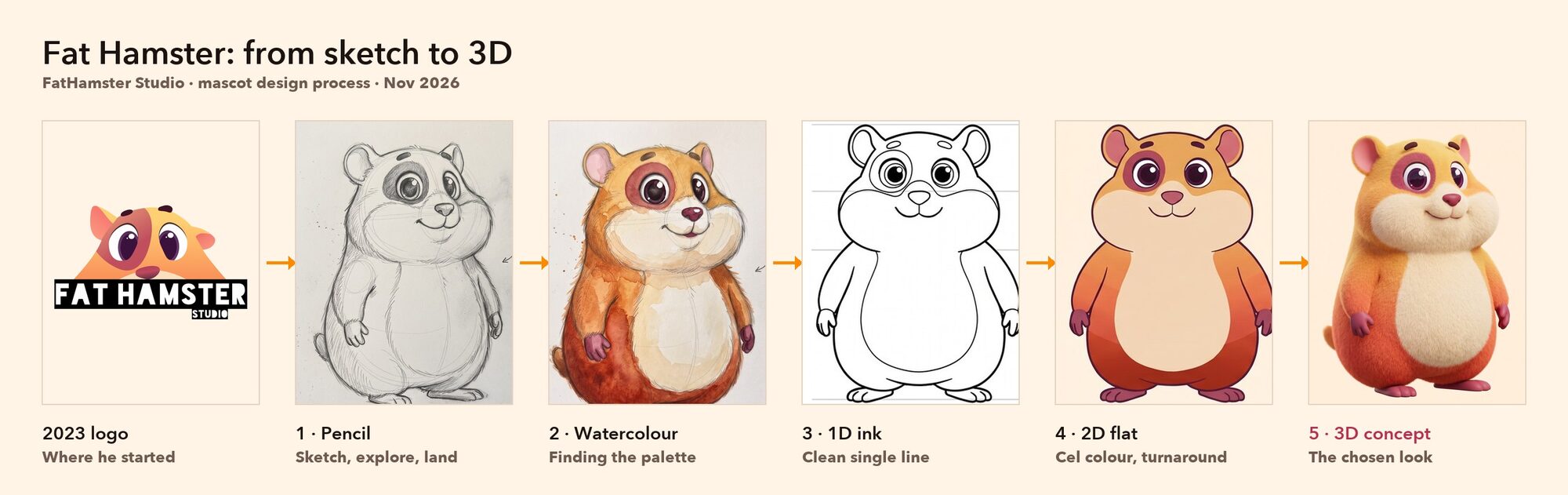
Tools: Higgsfield, Nano Banana Pro. About 12 credits.
Chapter 06 · 3D concepts
What should he look like in 3D?
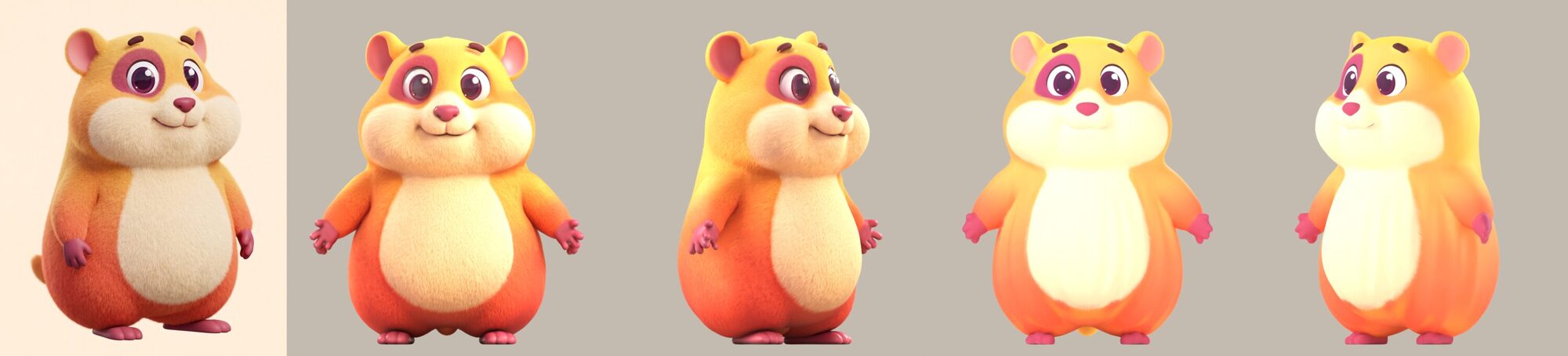
A concept painter shows the director a few 3D-style options before a modeller spends 80 hours or more. We fed three frames of the 2023 animation in and asked for a cute, cool feature-film version.
Traditionally
A concept artist paints three or four options: about 40 hours.
How we did it
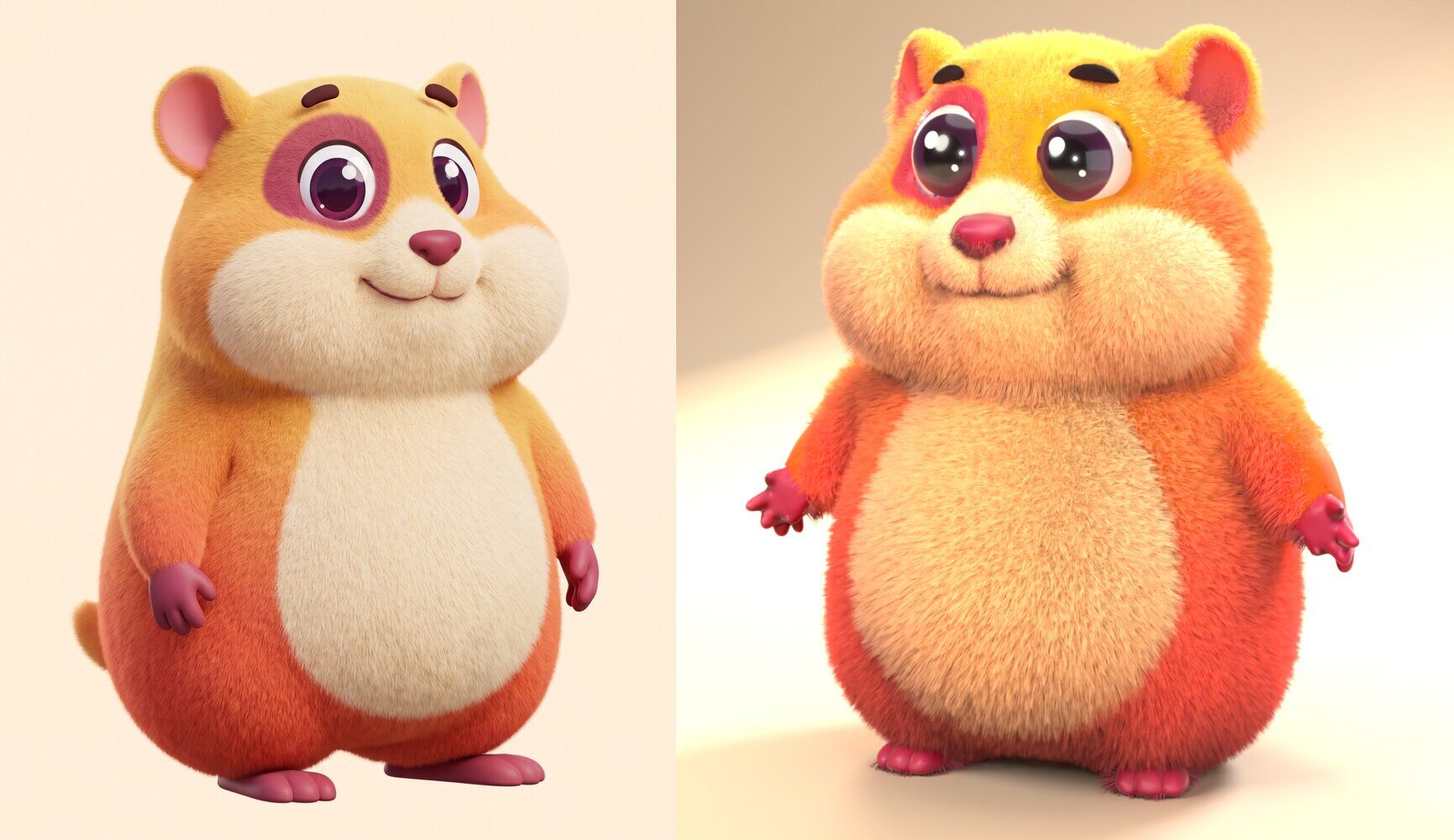
Four options in one go, a “cute, cool 3D animated-film” redesign from three frames of the 2023 animation. Aaron picked #4, the extra-fluffy one.
What didn’t: option #3 put the eye patch on the wrong eye. AI doesn’t always keep a brand rule, so someone has to check.
in a small studio, the traditional way
Estimate
with AI, our real time from the worklog
Worklog, 25–26 Nov 2026
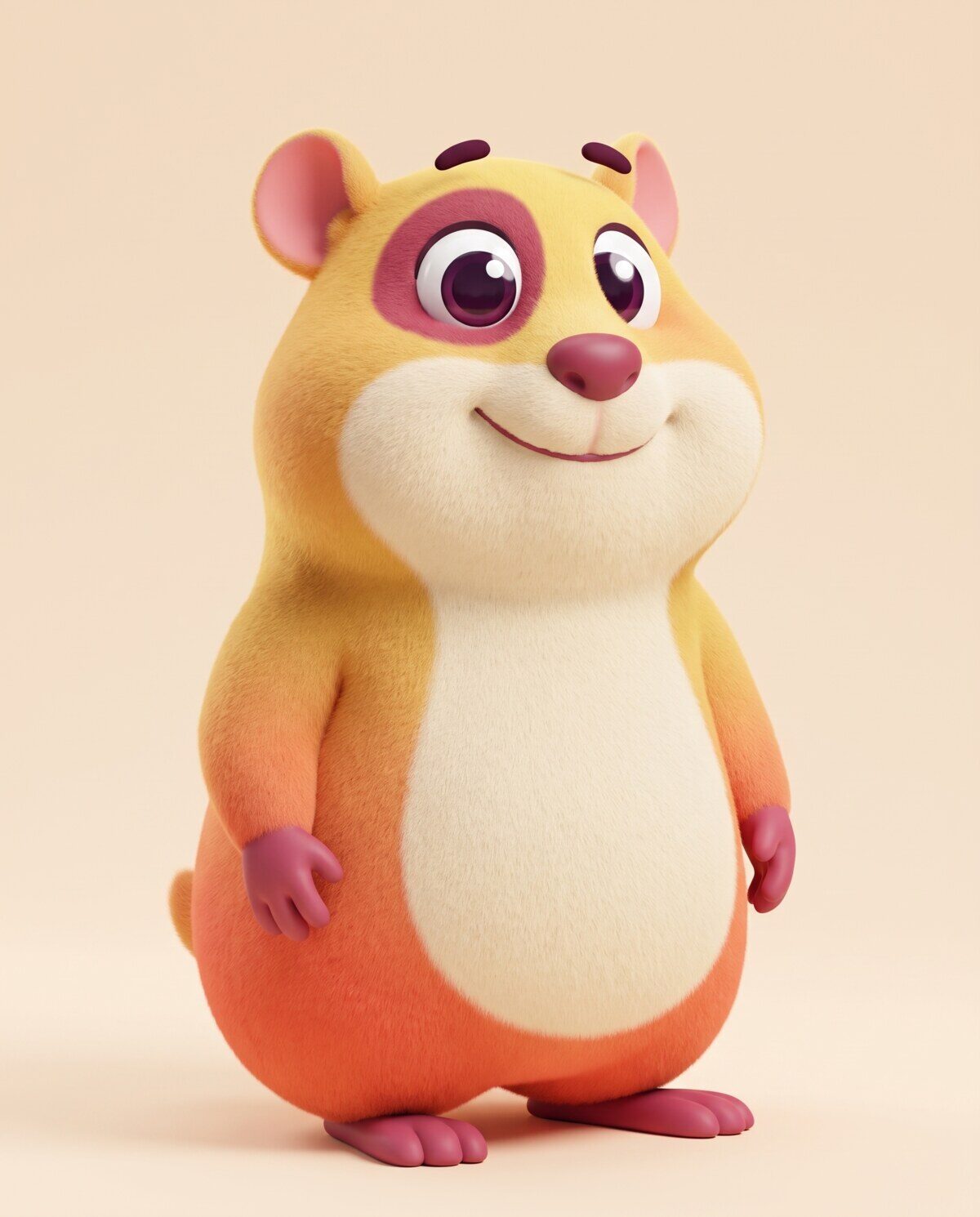
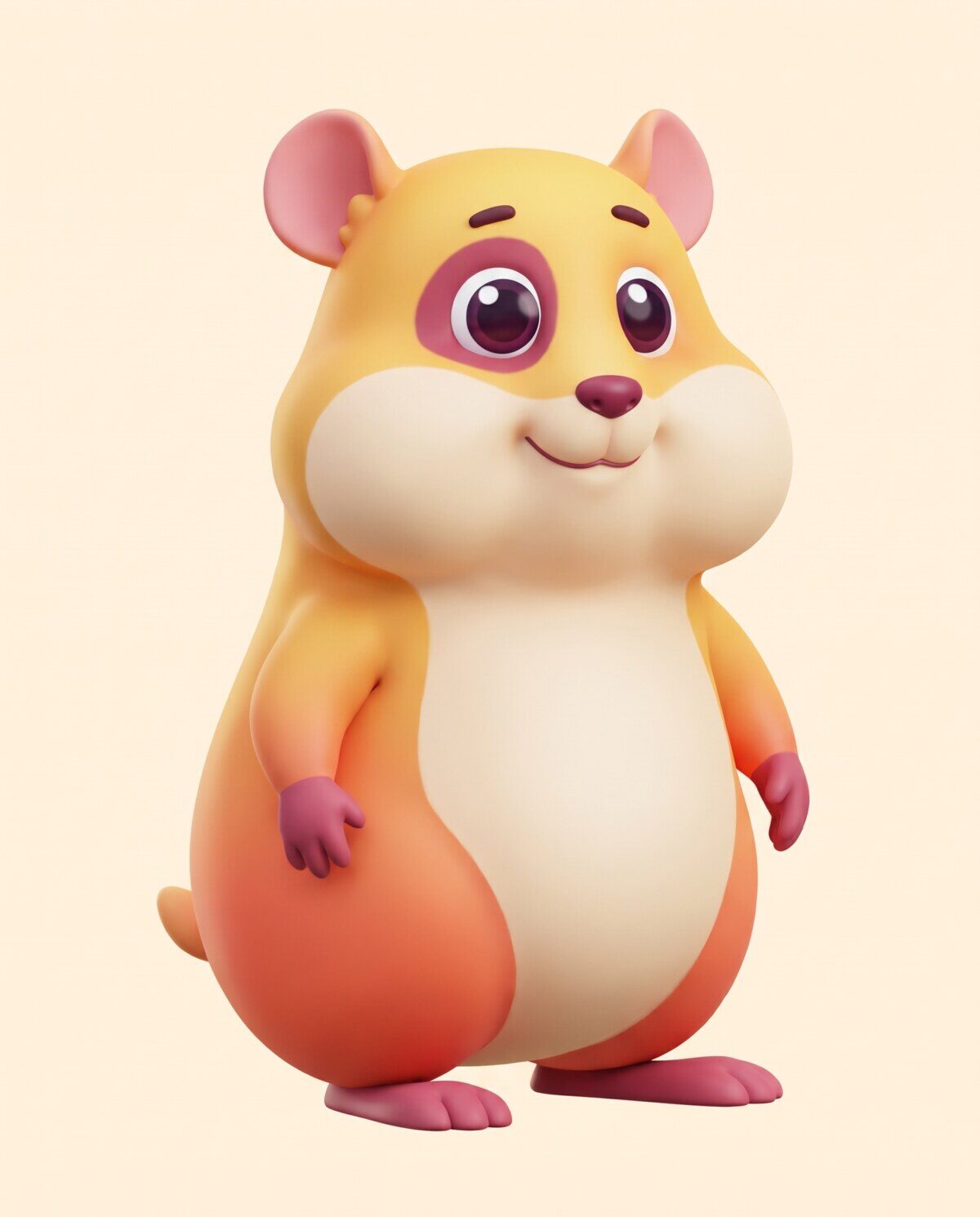
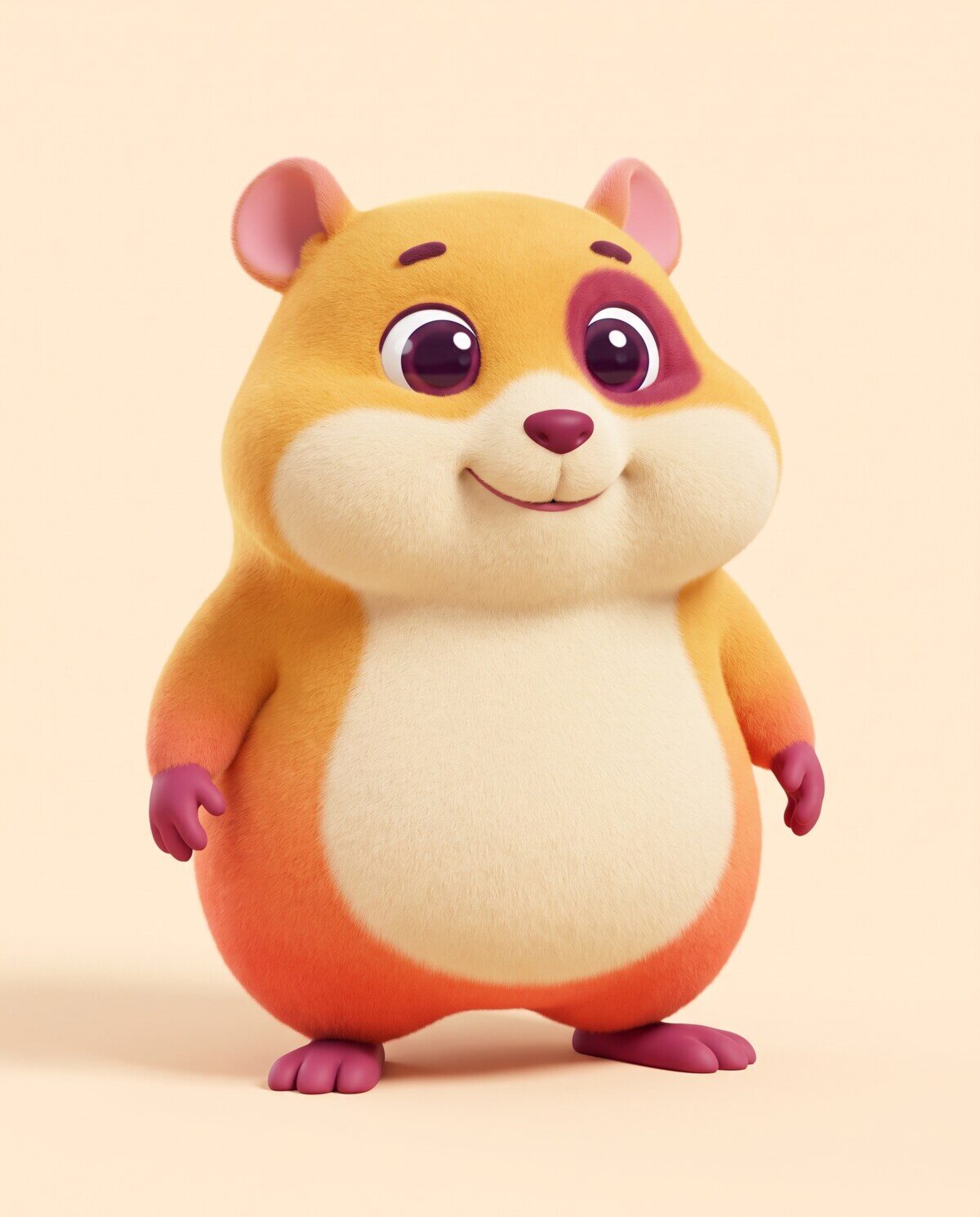
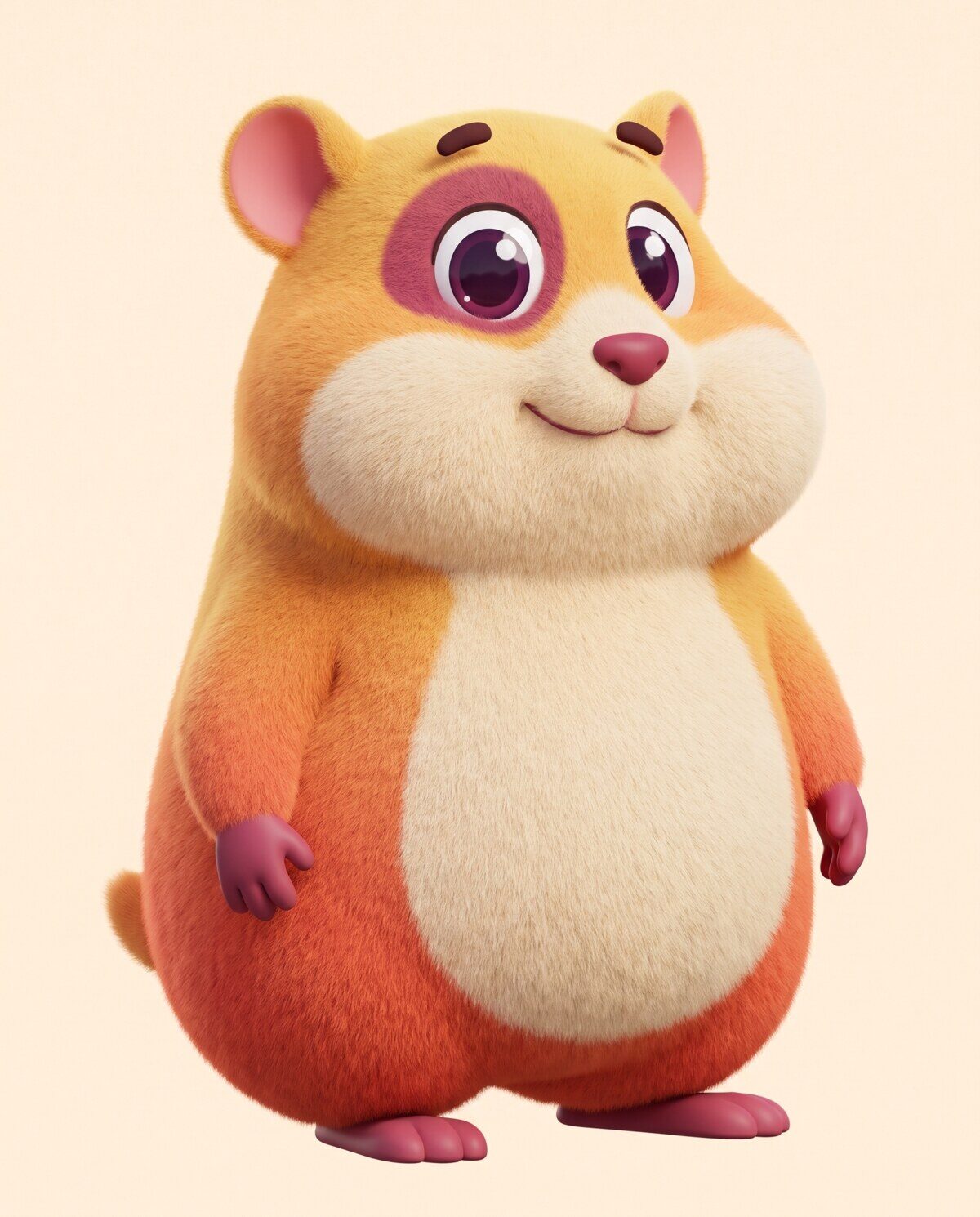
Tools: Higgsfield, Nano Banana Pro. About eight credits.
Chapter 07 · First 3D tries
Two Blender models we threw away
Before the concept existed, Claude built the hamster in Blender entirely from code: a sphere shaped into a body, eye sockets, a mouth, arms, ears, fur. Then we reshaped it towards concept #4. Neither was good enough.
Try 1: a Blender Python script box-modelled the hamster from a quad sphere: inset eye sockets, a mouth with lip loops, extruded arms, feet, ears and a tail, a baked procedural fur-colour texture, blend shapes and particle fur.
Try 2: the same model re-proportioned to concept #4: fatter, with cheek pouches, a round eye patch and the new palette. Bugs fixed on the way: shape keys defaulting to full strength (he blinked and puffed his face), inner faces left inside the limbs (ridges), and mouth points bunching at the corners.
What worked
A clean, animation-friendly mesh, working face shapes and fur, all written as reusable scripts.
What didn’t
It looked like a generic toy. Aaron’s verdict on the second try: “it’s too far away” from the concept. Code gets the structure right, but not the charm.
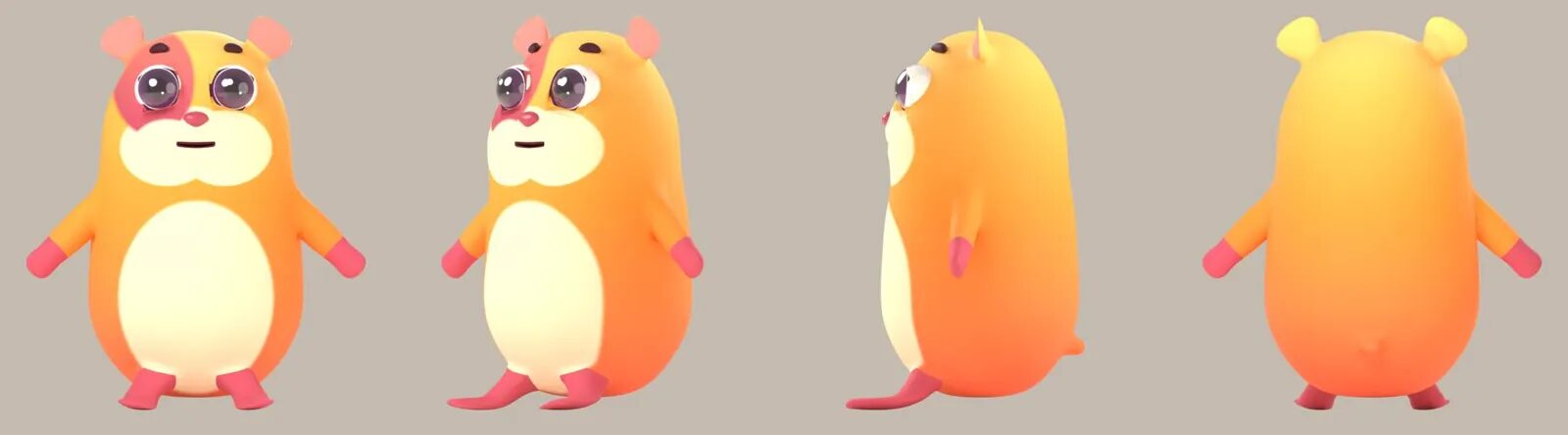
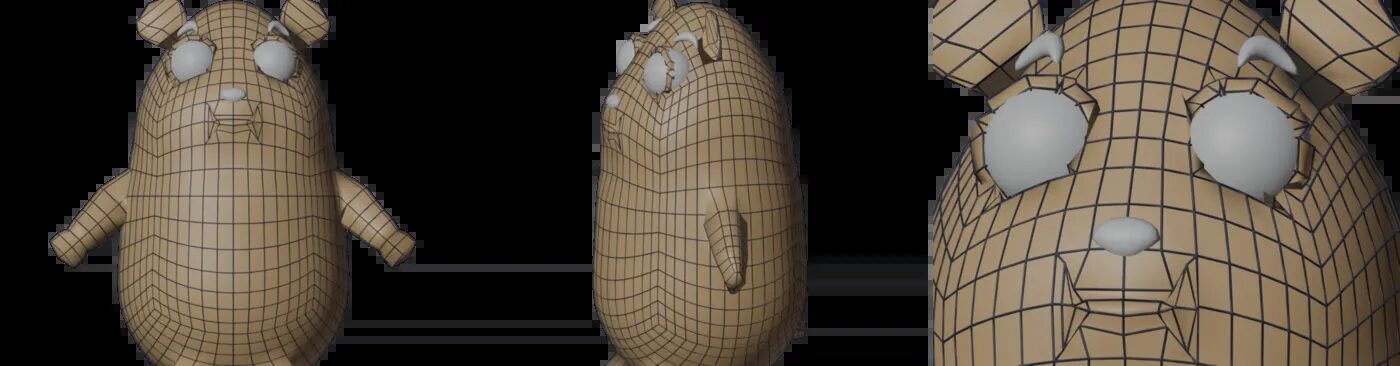
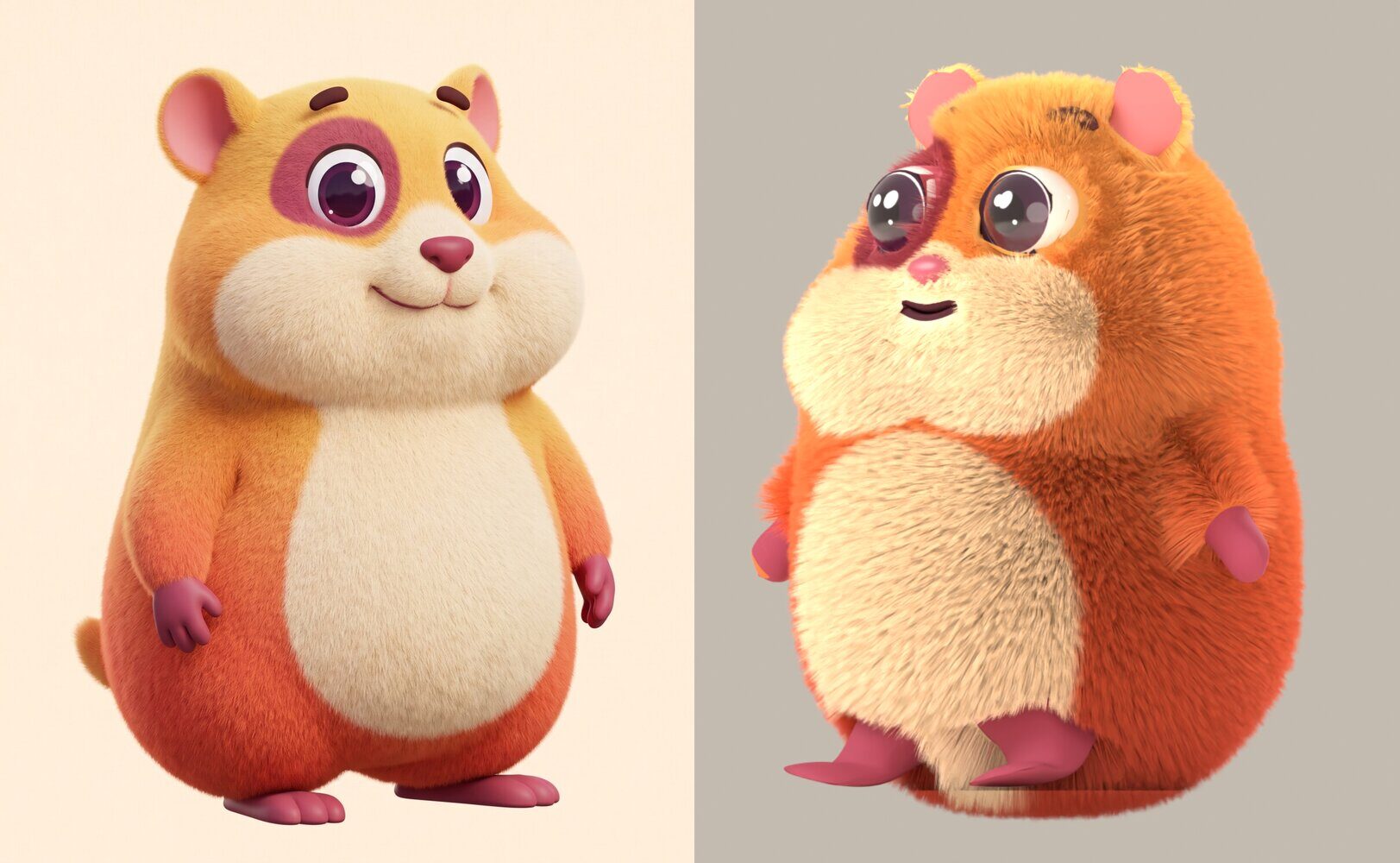
Tools: Blender 5.3 via Python, Claude Code.
Chapter 08 · 3D model
From one picture to a 3D sculpt
A modeller normally sculpts the character from the turnaround over 80–120 hours. We made clean front, side and back views of concept #4, then gave them to two image-to-3D engines and compared.
Traditionally
Sculpt in ZBrush from the turnaround, with director reviews: 80–120 hours.
How we did it
Three views in the A-pose (arms slightly out, so they bend well later), then Tripo H3.1 multiview (18 credits) and Meshy multi-image (30 credits) in parallel. Tripo’s 1.9-million-triangle result was much closer to the concept.
Not picked: Meshy, smoother and lighter, with less character.
in a small studio, the traditional way
Estimate
for the image-to-3D run; 5 hours for the whole stage, the two failed tries included
Worklog, 25–26 Nov 2026
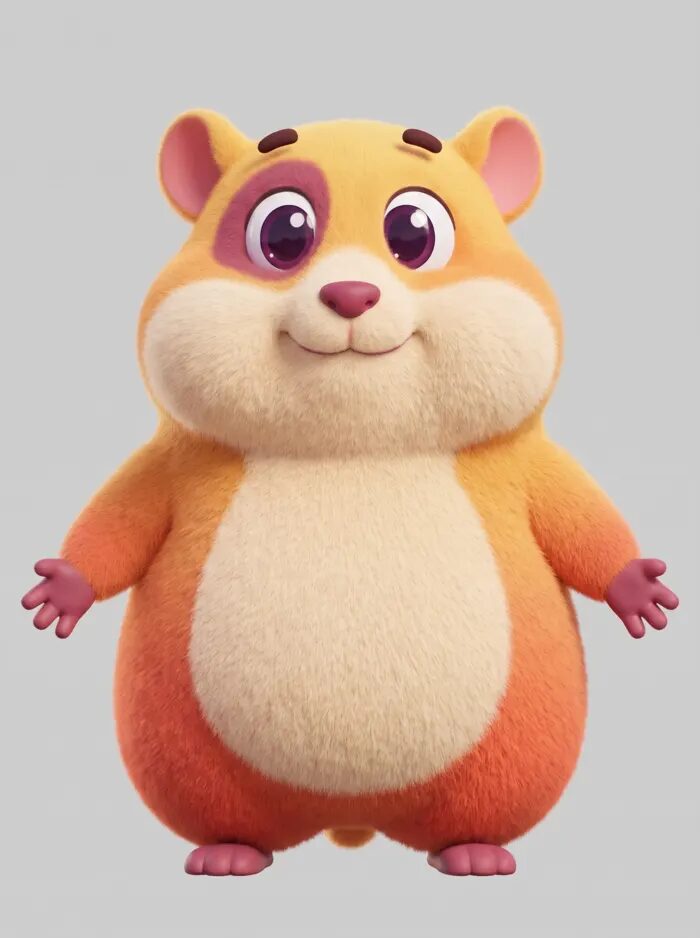
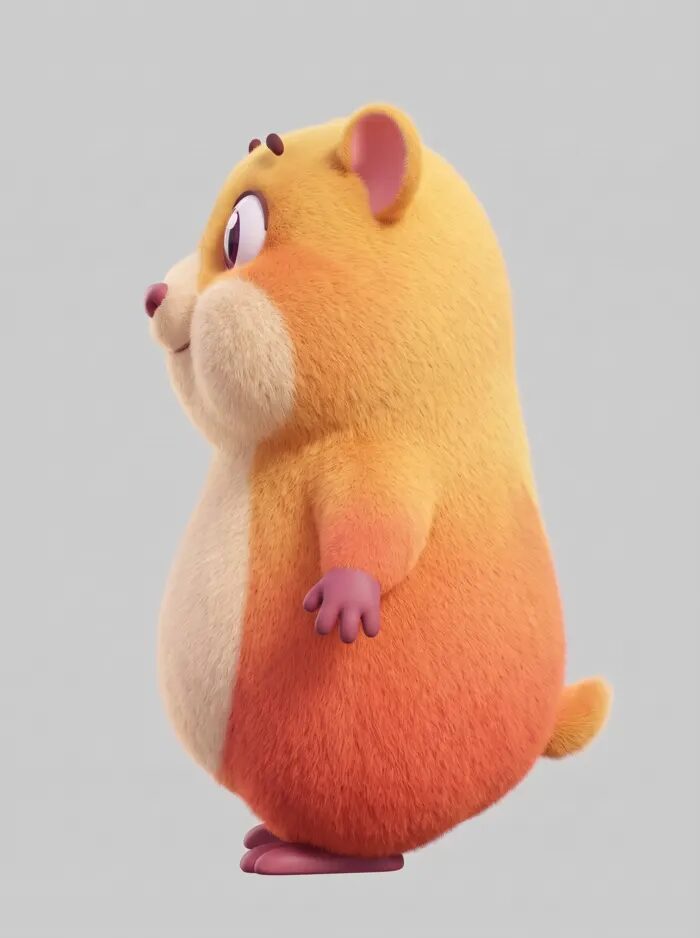
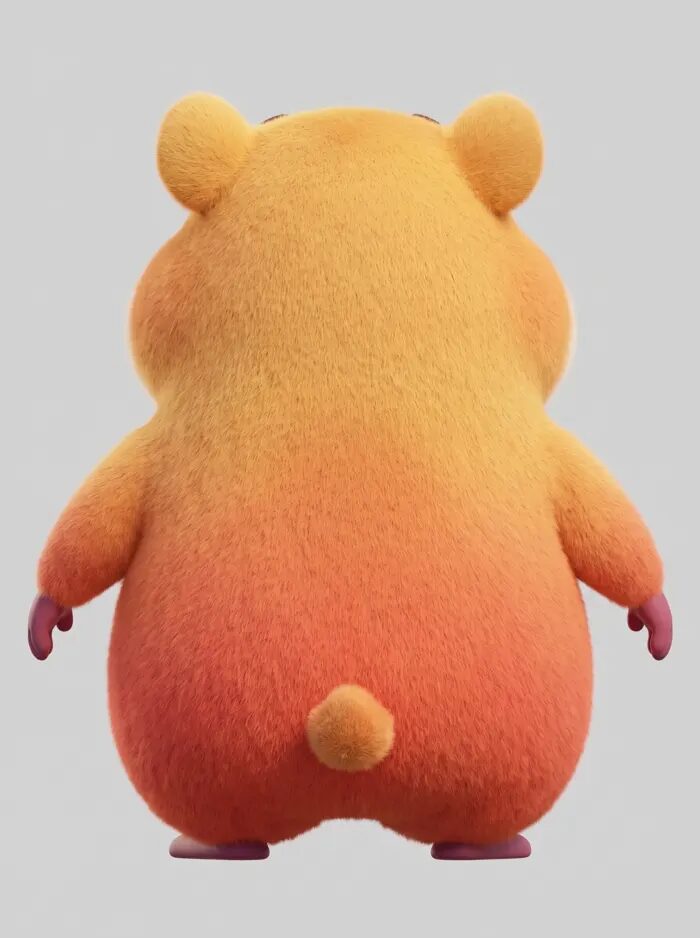
Tools: Nano Banana Pro, Tripo H3.1, Meshy. About 54 credits, views included.
Chapter 09 · Rig-ready
Making the sculpt animatable
A raw scan can’t be animated: too heavy, a messy surface, eyes painted on. So we rebuilt it the way a technical artist would, with every step scripted in Blender.
Set up
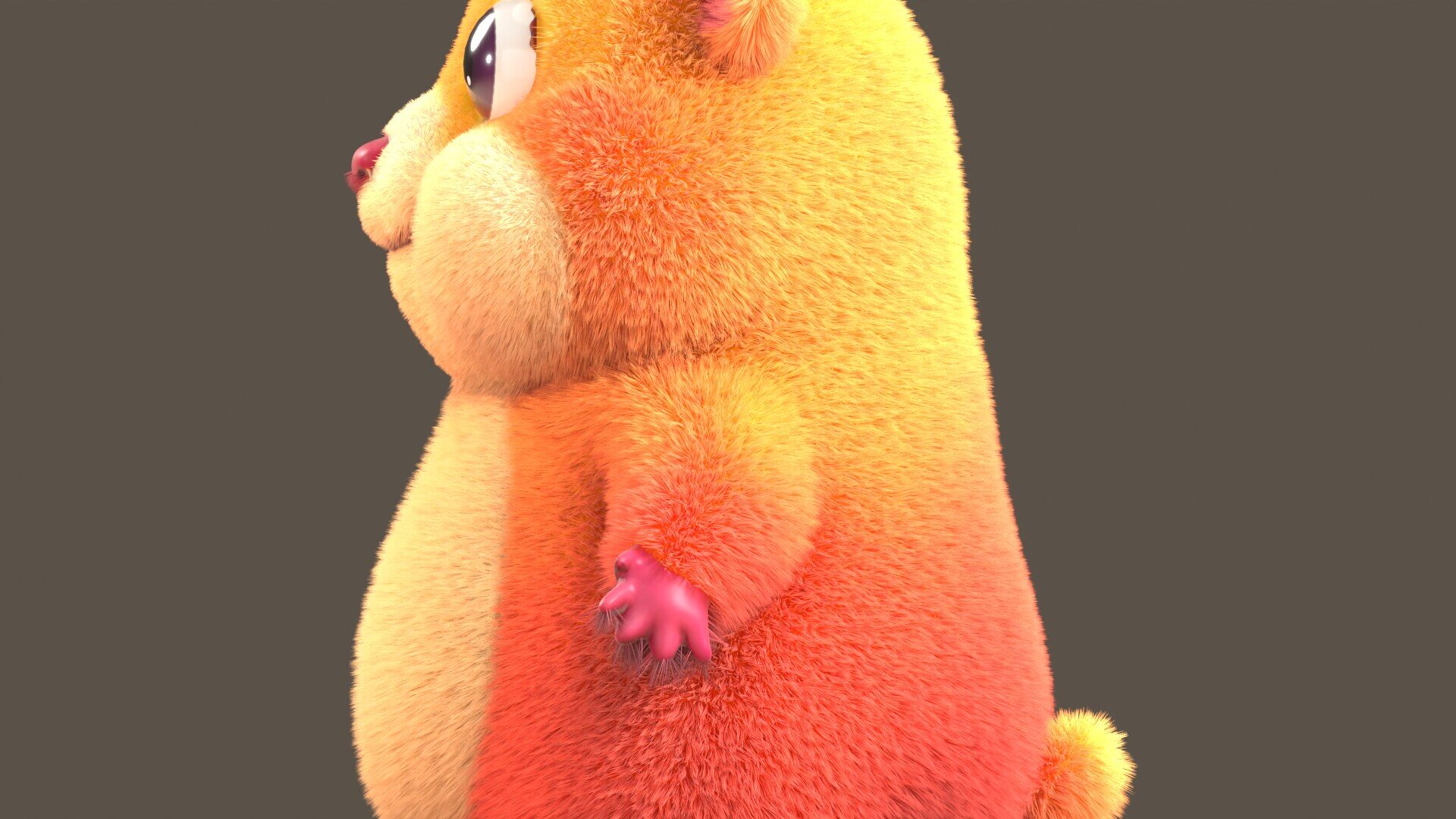
Turned it to face front, scaled it to 1.0 m, feet on the floor.
Clean mesh
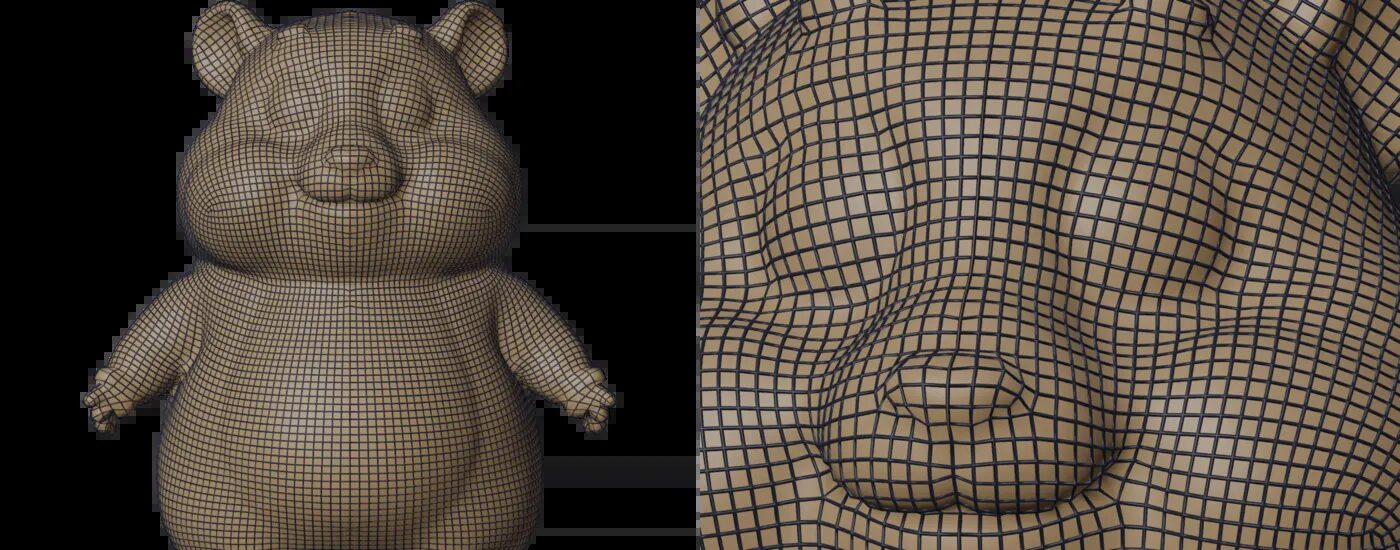
Voxel remesh and QuadriFlow: 1.9M triangles rebuilt as 14,263 clean four-sided faces, mirrored left to right.
Textures
UV unwrap, then the colour and surface detail (a normal map) baked from the scan onto the light mesh.
Real eyes
Painted eyes found by colour, cut out, and replaced by real eyeballs that look around, with lid rims so they can blink.
Movable brows
Painted brows painted out of the texture and replaced with movable meshes.
Face shapes
Blink left and right, smile, frown, cheek puff.
Exports
.blend (source), .glb (3 MB, for the web), .fbx (for animation tools).
in a small studio, the traditional way
Estimate
with AI, our real time from the worklog
Worklog, 25–26 Nov 2026
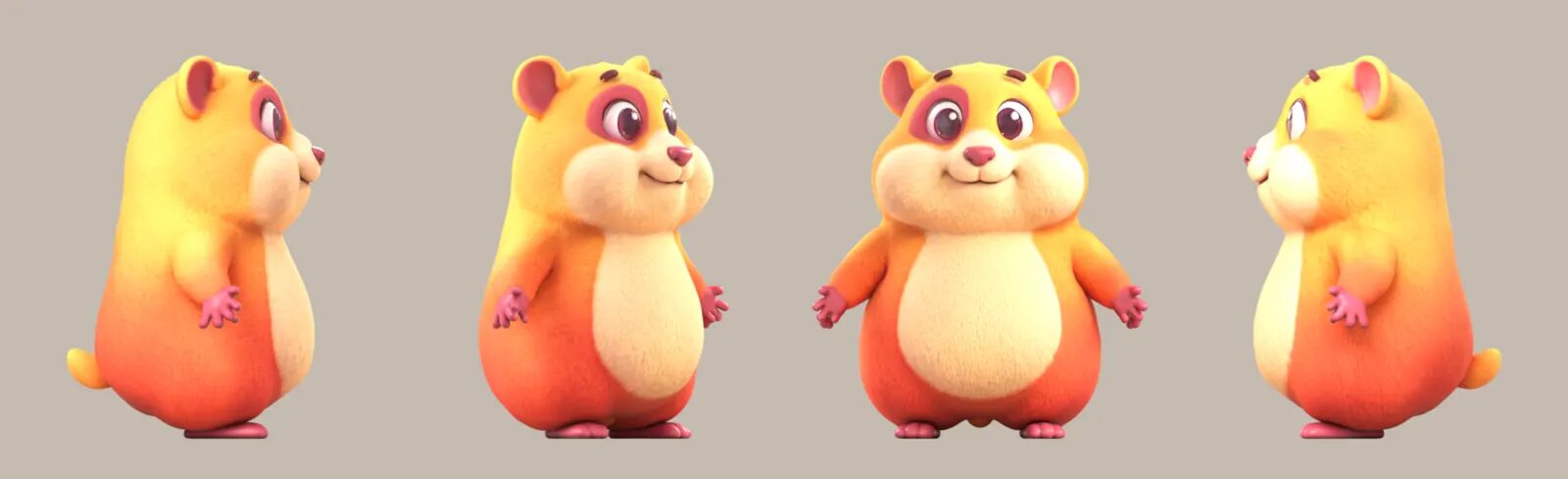
- Pose
- Standing, arms slightly out (A-pose), so the arms bend cleanly when animated
- Size
- 1.0 m tall: about 0.66 wide at the cheek pouches and hips, 0.68 deep, eyes centred at 0.83 of the height
- Face
- Real eyeballs that look around and blink, eyebrows that move, smile, frown and cheek-puff shapes
- Mesh
- 14,263 clean four-sided faces, left and right mirrored
- Still to build
- A mouth that opens for talking, when the animation needs lip sync on the rig
Tools: Blender, QuadriFlow, Python scripts. No generation credits.
Chapter 10 · Texture & light
Fur, gloss and light
Look development is where a model becomes a character: how the fur catches light, how wet the eyes look, where the shadows fall. We lit him with a warm front light (the Goa sun) against a cool light from behind (the Nordic one).
Traditionally
Texture painting, shader and lighting tests with renders overnight: 40–80 hours.
How we did it
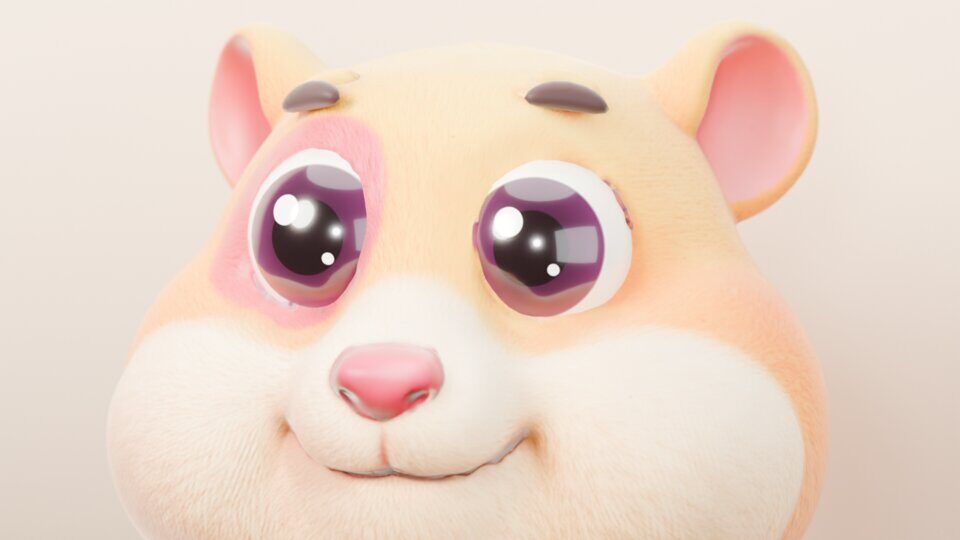
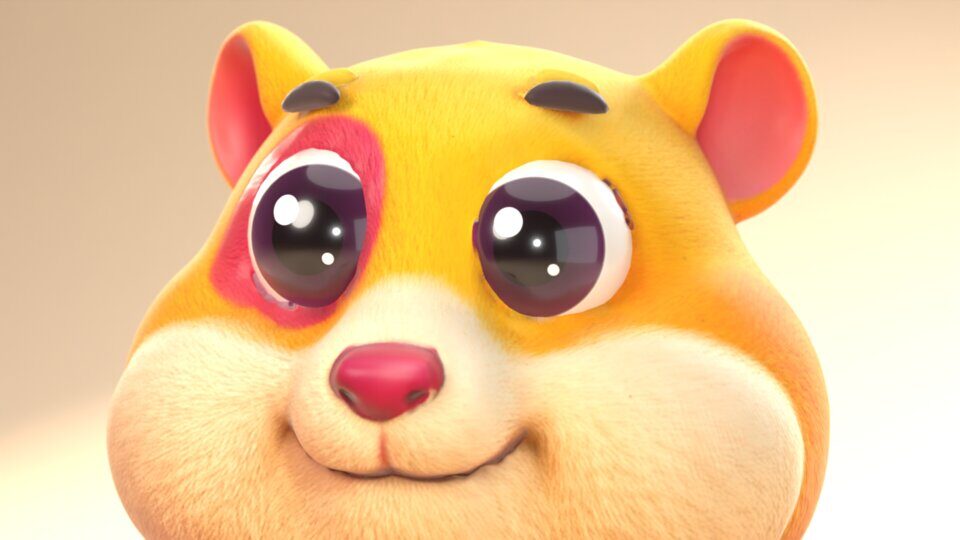
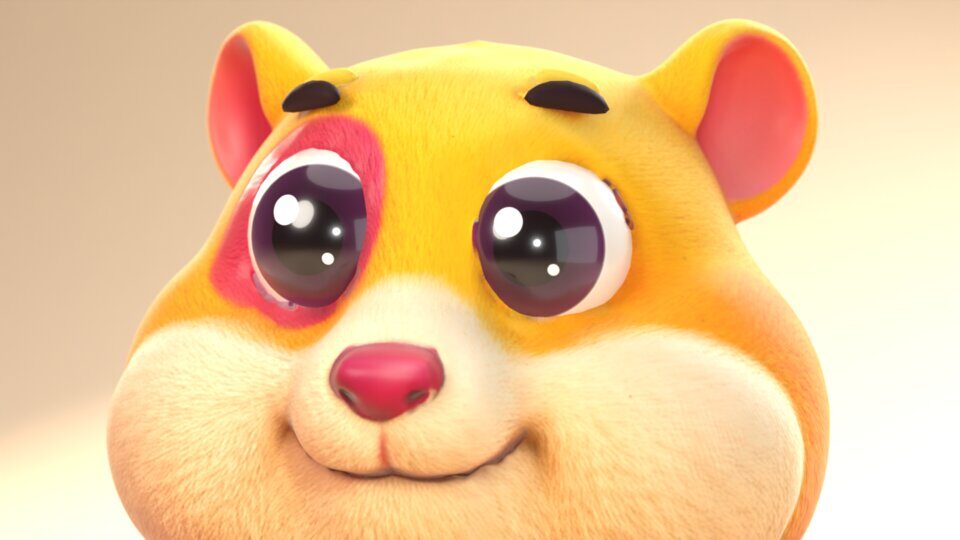
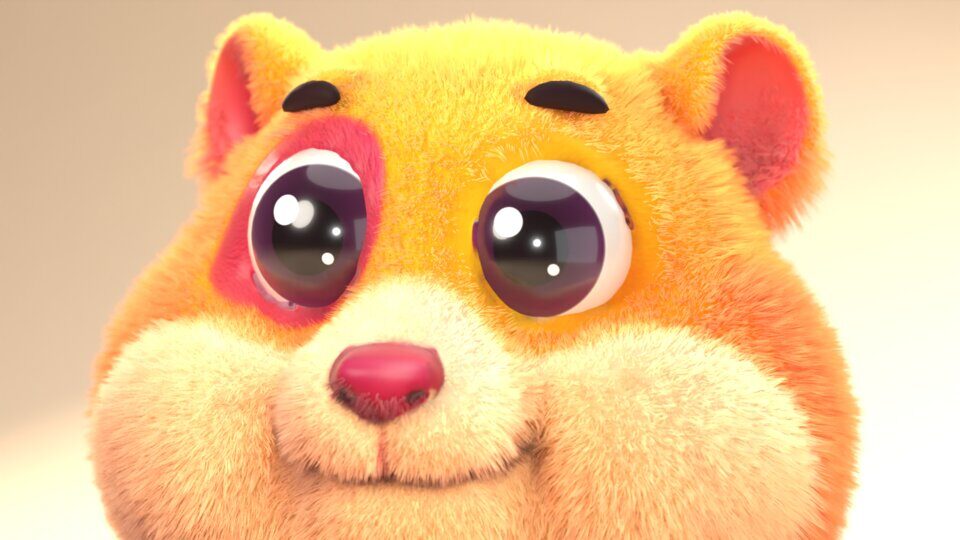
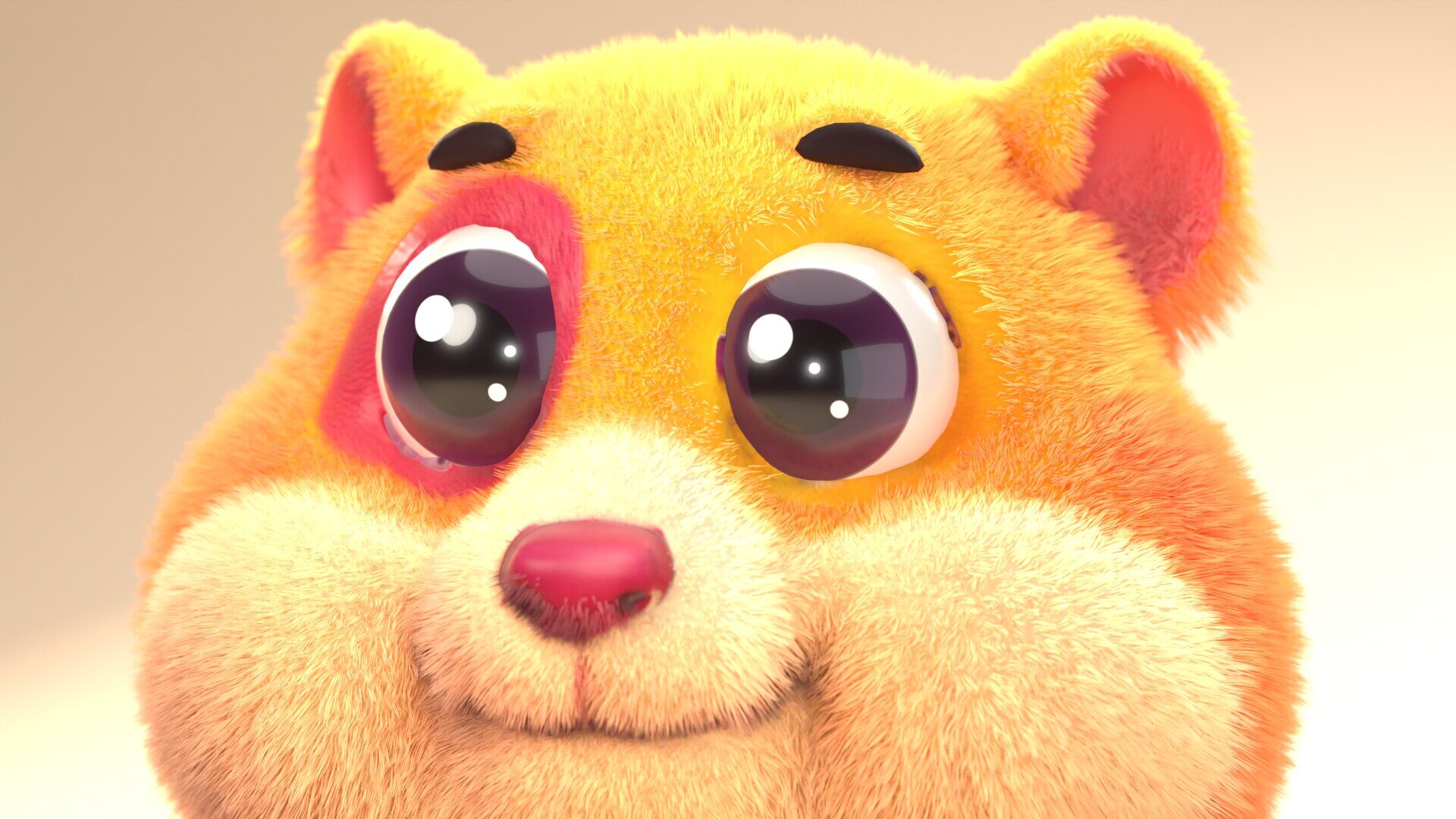
Glossier nose and paws than fur, velvety fur edges, wet glossy eyes, a dark lid line, then 90,000 strands of short fur coloured from his texture. Studio, lights and cameras saved in the file.
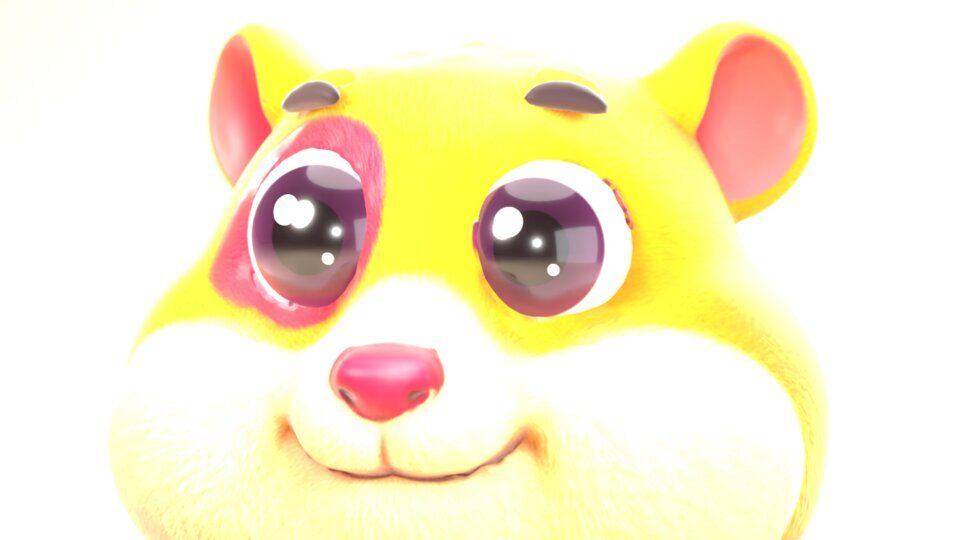
What didn’t: film-style colour (AgX) bleached him to pastel, the first backdrop was built backwards and blocked the camera, then it was overexposed. Five rounds to the final look.
in a small studio, the traditional way
Estimate
with AI, our real time from the worklog
Worklog, 25–26 Nov 2026
Materials
The baked colour and normal map, plus a roughness map made from the colour map, a light sheen for velvety fur edges, and a touch of subsurface so he reads soft instead of plastic. Glossy, wet eyes with a clear coat.
Fur
Short particle fuzz: 90k guide hairs, six children each, about 6.5 mm long. Off on the face rims, the eyes and the pink parts. Render-only: the web model stays fur-free.
Lights
Warm key from the front left, cool rim from behind, a soft fill, a top light, a second warm rim, and a small catch light for the eye sparkle, on a curved paper-coloured backdrop.
Cameras and colour
CAM_Hero (55 mm, shallow depth of field on the eyes), CAM_Face (105 mm), and orthographic front and side cameras for sheets. Colour management on “Standard”, which keeps the brand orange.
Tools: Blender Cycles, particle fur. No generation credits.
Chapter 11 · Storyboard
Write it, board it
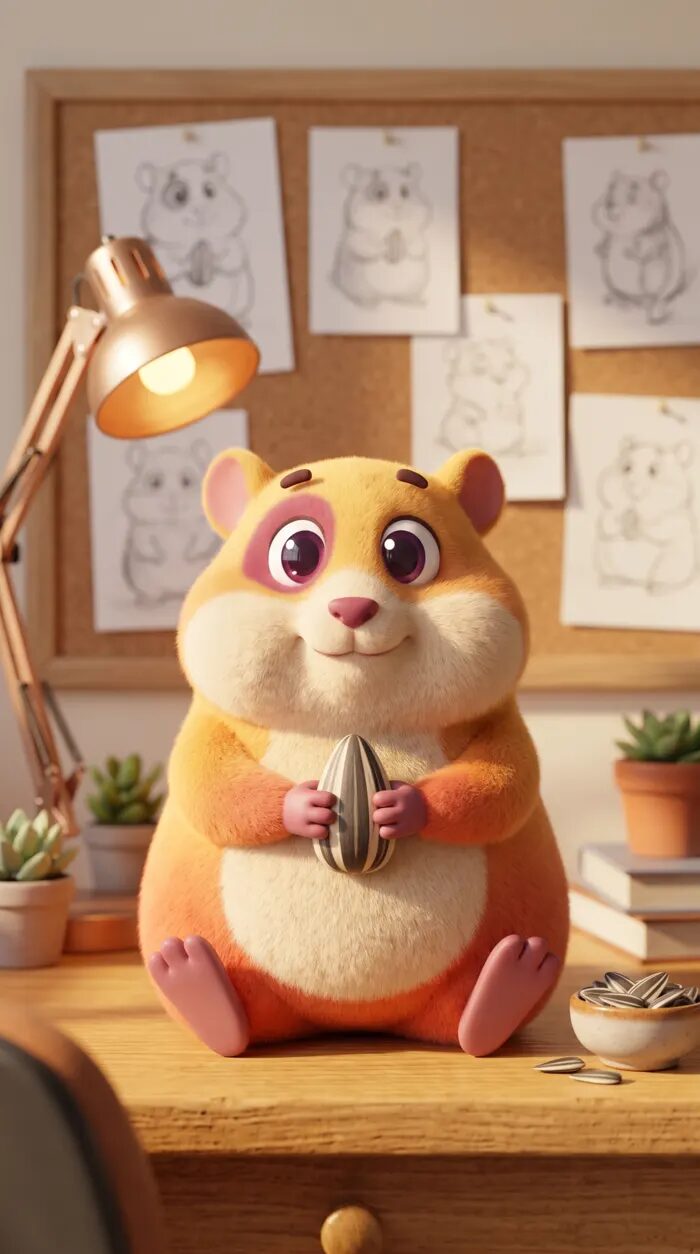
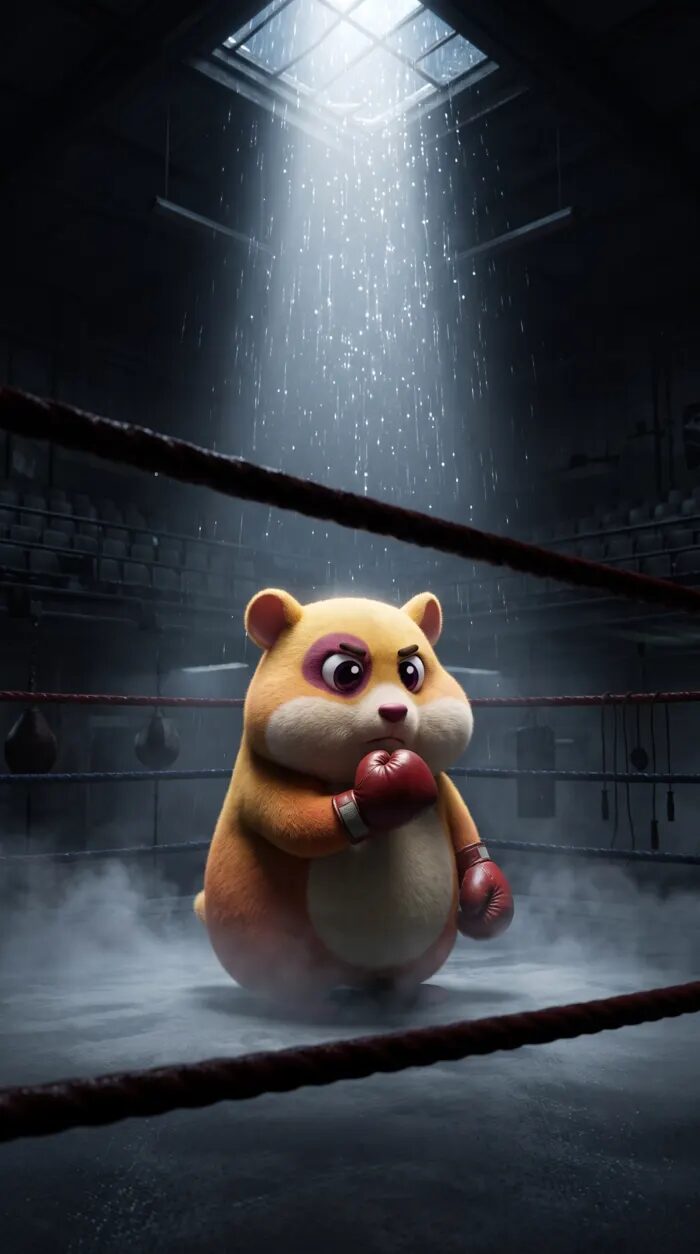
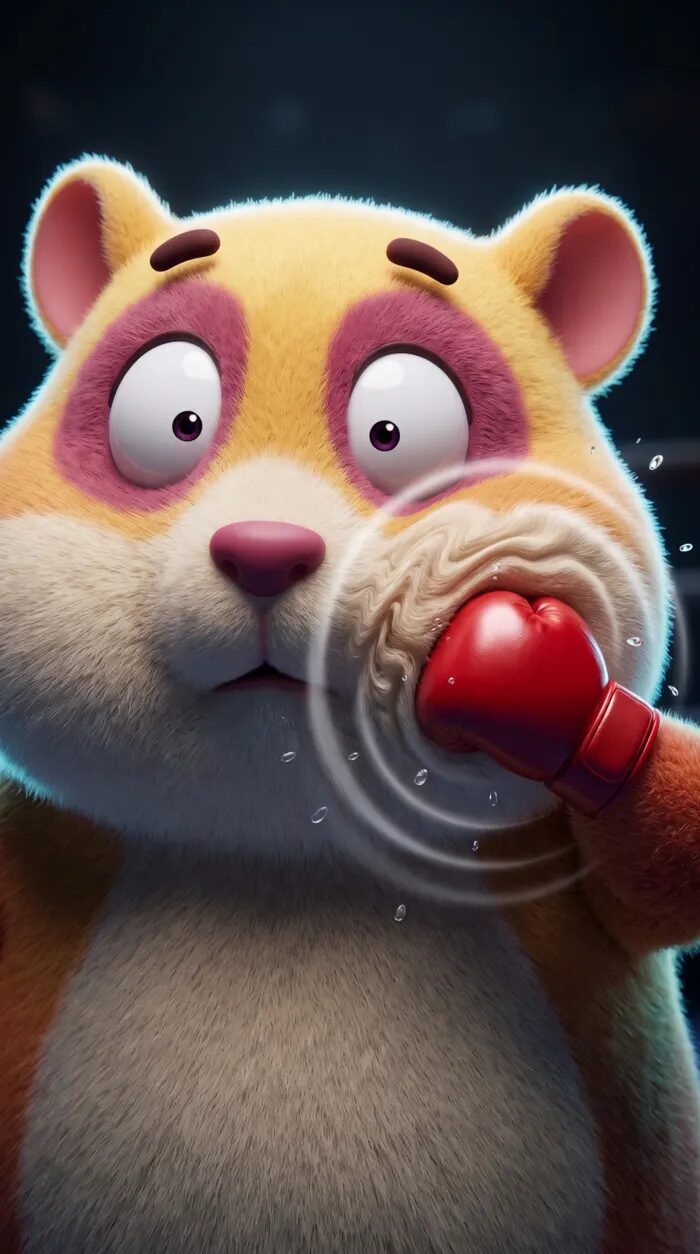
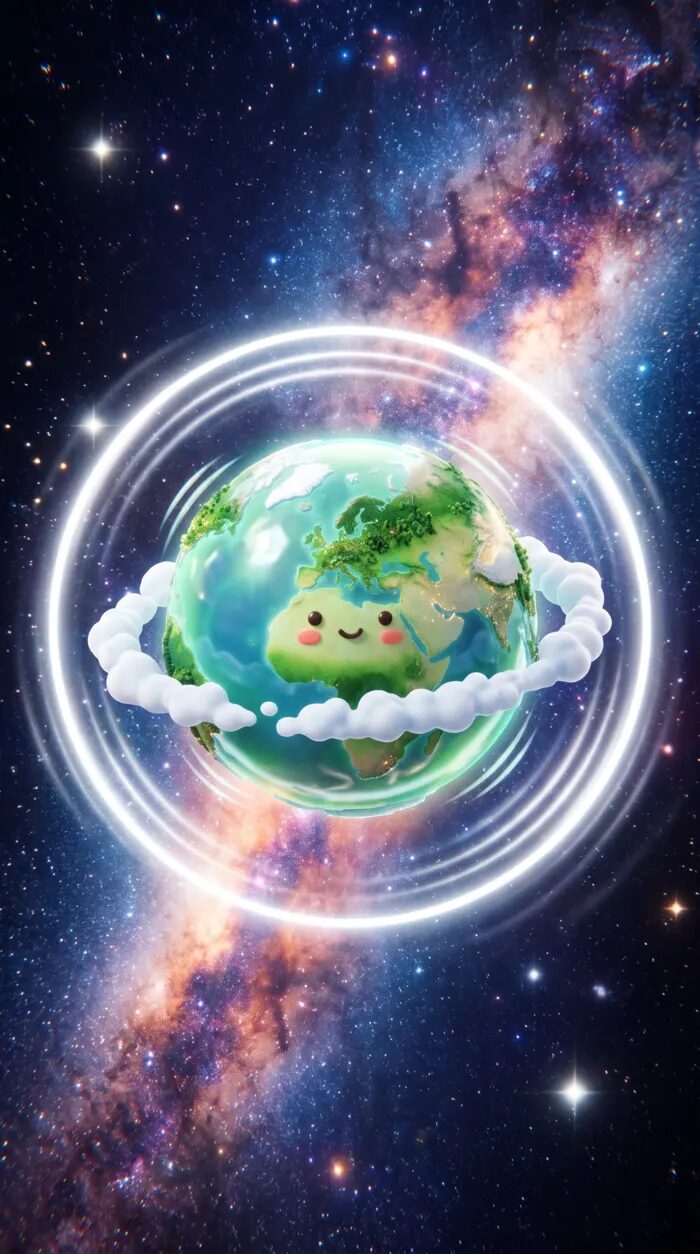
A short starts as a script and a storyboard: one frame per beat. We created a series format, “Hammie Wonders”: a silly question asked like the end of the universe. Each episode’s keyframes are its storyboard.
Traditionally
Script, storyboard artist, animatic: about 40 hours per short.
How we did it
A script with timings and sound cues for every beat, then one still per beat, all from the approved concept so he stays on-model.
What worked: reusable shots. The cosy-desk opening and the end card are made once and reused every episode, which cut the cost of later episodes.
in a small studio, the traditional way
Estimate
with AI, our real time from the worklog
Worklog, 25–26 Nov 2026
Episode 01
If you punch yourself…
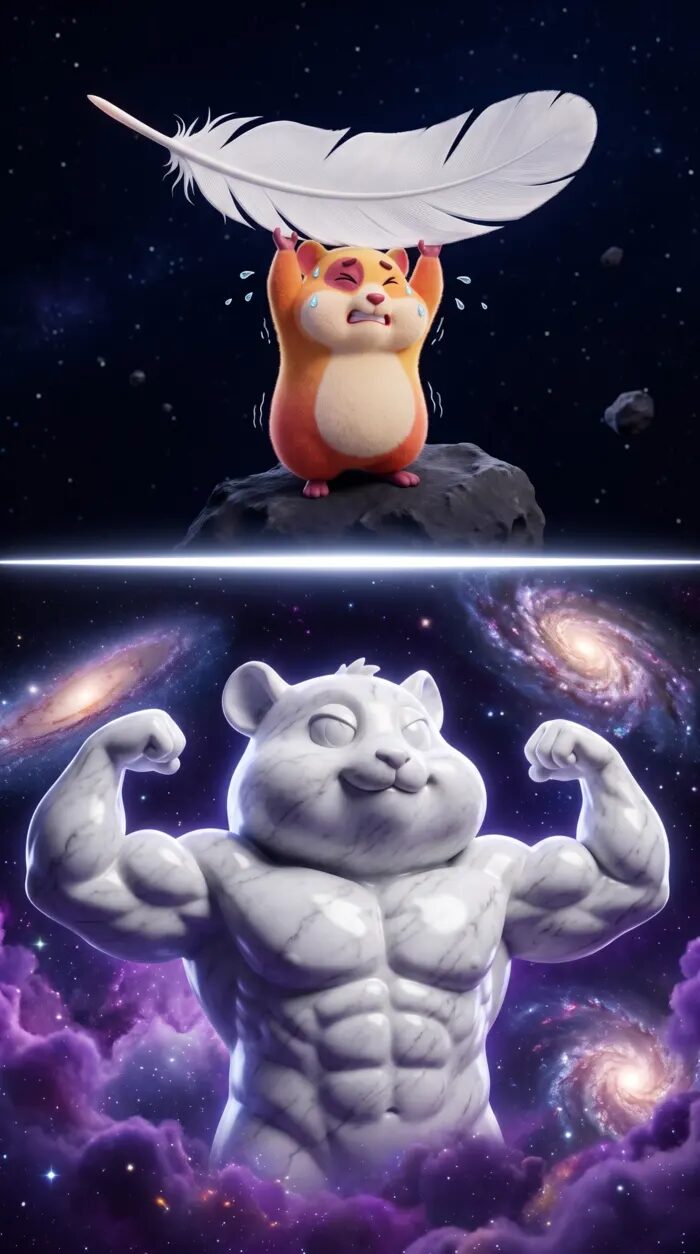
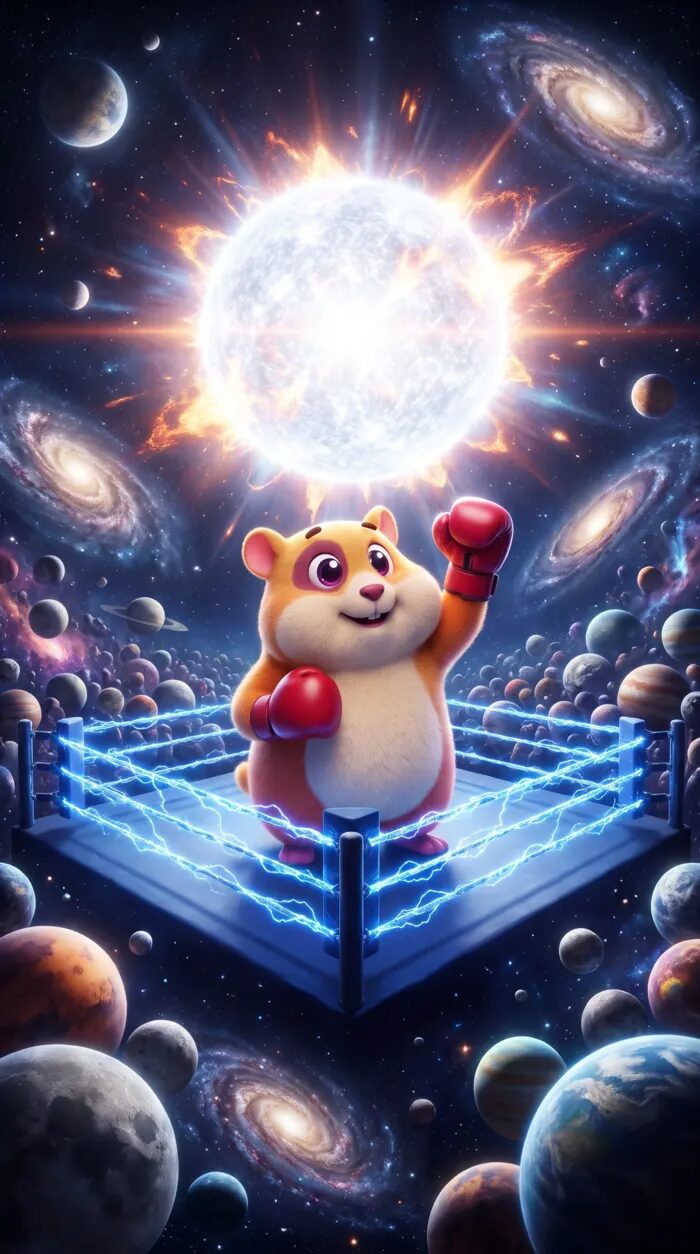
Episode 02
Expect the unexpected
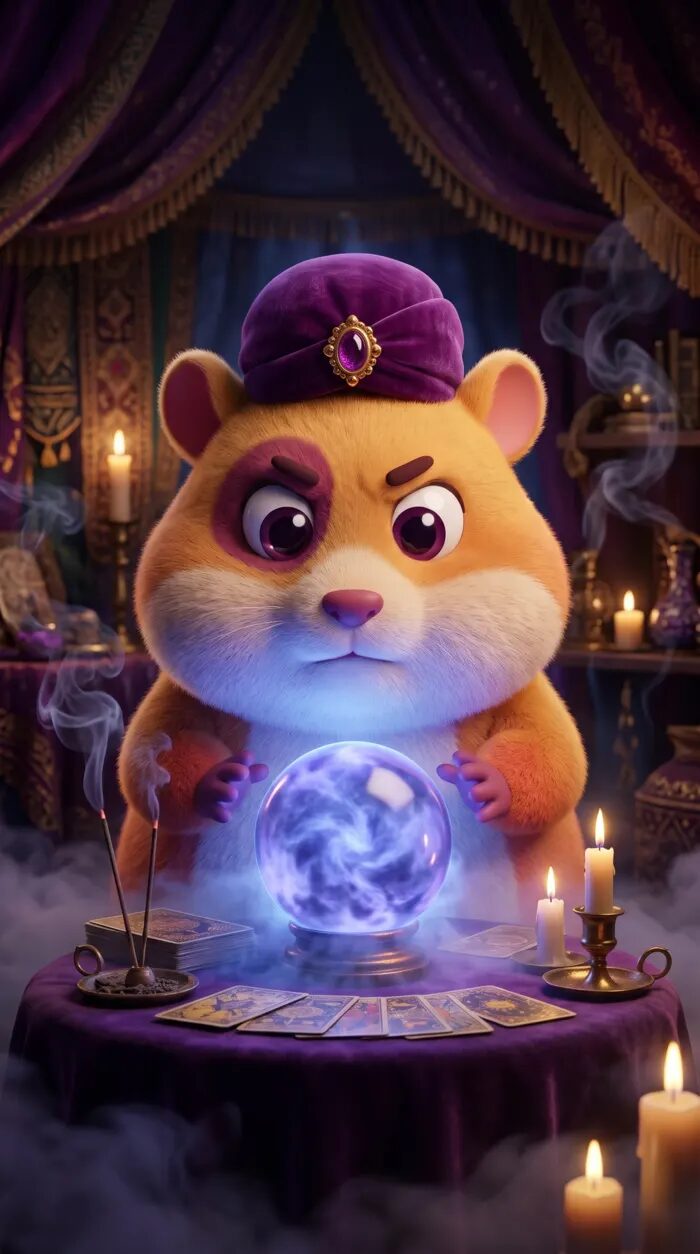
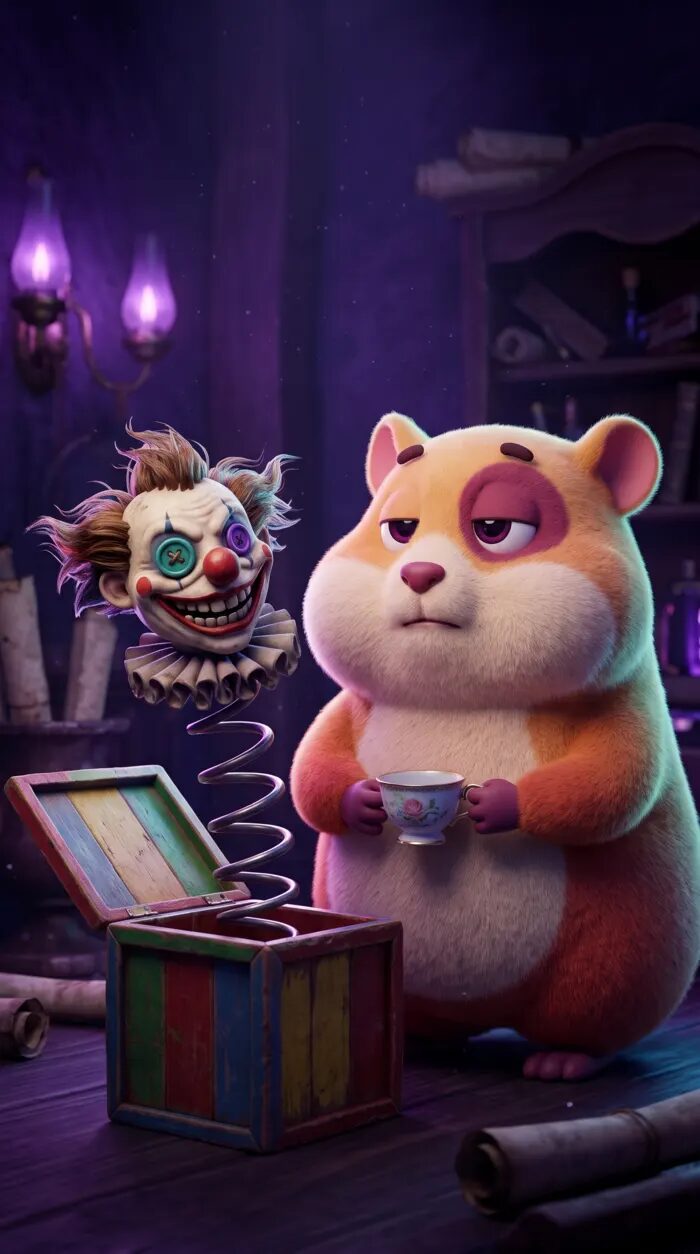
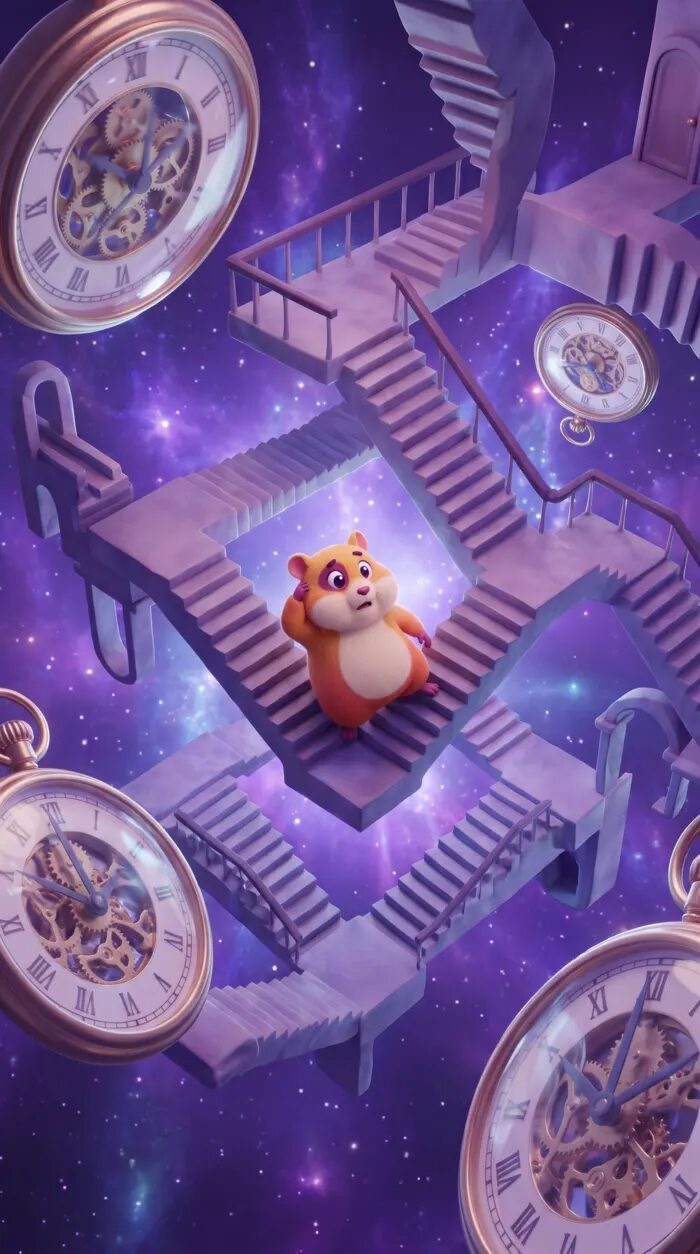

Tools: Claude Code, Nano Banana Pro. Credits counted with the films.
Chapter 12 · Animation
Making him move
Two tracks ran side by side. The 3D model already moves on its own (blinks, glances, a happy hop) and is going into a full rig. For the shorts, each storyboard frame was animated with AI video, then voiced with a cloned “Hammie” voice and lip-synced.
Traditionally
Rigging (40–80 hours), then key-frame animation of a 20-second short (120–200 hours), voice casting and recording, lip sync.
How we did it
3D: a short test animation keyed straight on the model’s face controls, rendered in Blender with fur. There is no rig yet, so the whole character squash-and-stretches from an empty at his feet, with blinks, eye darts, brow lifts, a smile and a cheek puff.
Shorts: each keyframe turned into a 5–12 second clip with Kling 3.0.
Voice: one “Hammie” voice cloned once for the whole series, lines spoken with hand-timed pauses, lips synced with Wan 2.7.
in a small studio, the traditional way
Estimate
with AI, our real time from the worklog
Worklog, 25–26 Nov 2026
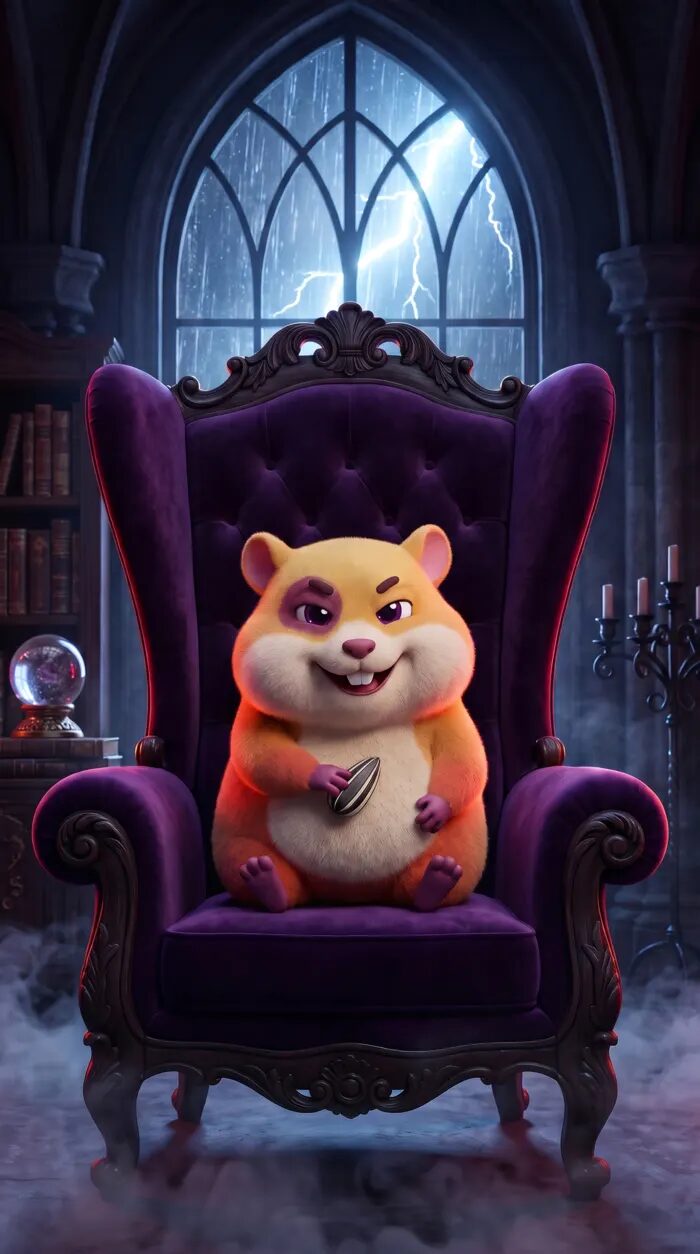
Tools: Blender, Kling 3.0, Wan 2.7 lip sync, voice clone. About 277 credits for the three films, storyboards included.
Chapter 13 · The films
Three finished shorts
Captions, end cards and layered sound design (up to 35 layers: rain, thunder, choirs, boings, a party popper), mixed to Instagram loudness. Press play with sound on.
| Film | Credits | Notes |
|---|---|---|
| Skit 01: POV: I’m the villain | ~52 | Three versions: v2 added buck teeth, v3 layered sound design |
| Hammie Wonders Ep 01 | ~152 | Two versions, including the one-off voice clone |
| Hammie Wonders Ep 02 | ~73 | Reuses the opening shot |
Chapter 14 · The numbers
What it took
Every stage, side by side: a small studio’s typical schedule against our real time.
| Stage | Traditional (estimate) | With AI (actual) | Tools | Credits |
|---|---|---|---|---|
| Brief and character | 24–40 hours | 1 hour | Claude Code | 0 |
| Pencil sketches | 40–80 hours | 20 minutes | Nano Banana Pro | ~16 |
| Colour studies | 24–40 hours | 10 minutes | Nano Banana Pro | ~6 |
| Line art and turnaround | 40–80 hours | 20 minutes | Nano Banana Pro | ~12 |
| 3D concept art | 40 hours | 10 minutes | Nano Banana Pro | ~8 |
| 3D modelling | 80–120 hours | 5 hours, two failed tries included | Blender, Tripo, Meshy | ~54 |
| Rig-ready model | 40–80 hours | 3 hours | Blender (scripted) | 0 |
| Texture and light | 40–80 hours | 2 hours | Blender Cycles | 0 |
| Script and storyboard | 40 hours | 15 minutes | Claude Code, Nano Banana Pro | in films |
| Animation and voice | 160–240 hours | 3 hours | Kling 3.0, Wan 2.7, voice clone | ~277 |
| Total | ~560–720 hours | ~17 hours (one day, parallel sessions) | One producer + AI | ~373 |
Credits are Higgsfield credits. Blender, Claude Code scripting and the Epidemic Sound effects added no generation credits. Our total time is shorter than the sum of the rows because several stages ran in parallel sessions.
Lessons
What we would tell another studio
Use AI for options
Four concepts in minutes made the creative choice faster and better. People still made every pick.
Engineer what you generate
Image-to-3D gave the look; scripted clean-up made it animatable: real eyes, movable brows, face shapes, a clean mesh.
Check the rules
The eye patch drifted to the wrong eye more than once. Brand rules need a human, or a script, checking every output.
Want results like these?
Tell us about your project. We’ll show you how we would approach it, and what it could deliver.
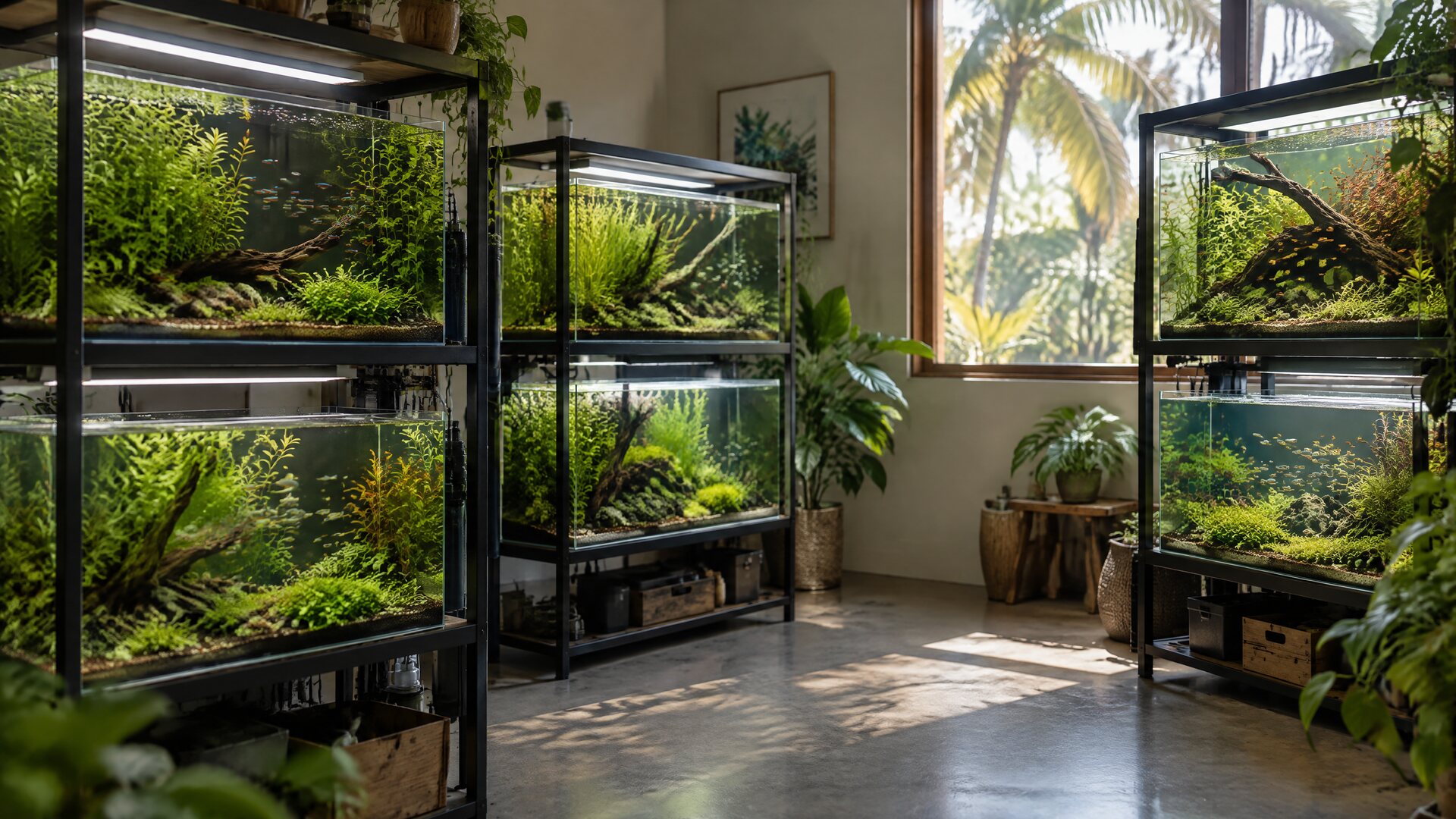
An aquarium business built and run by AI: about 2,480 hours of work in about 230
Aquatic Hideout is an aquarium price-comparison site, an Instagram channel, a fish studio, and an app in Goa, India, all built and run with AI. About 2,480 hours of work by hand, done in about 230. Website users went from 34 to 1,426 a month; Instagram followers from 33 to 3,137.
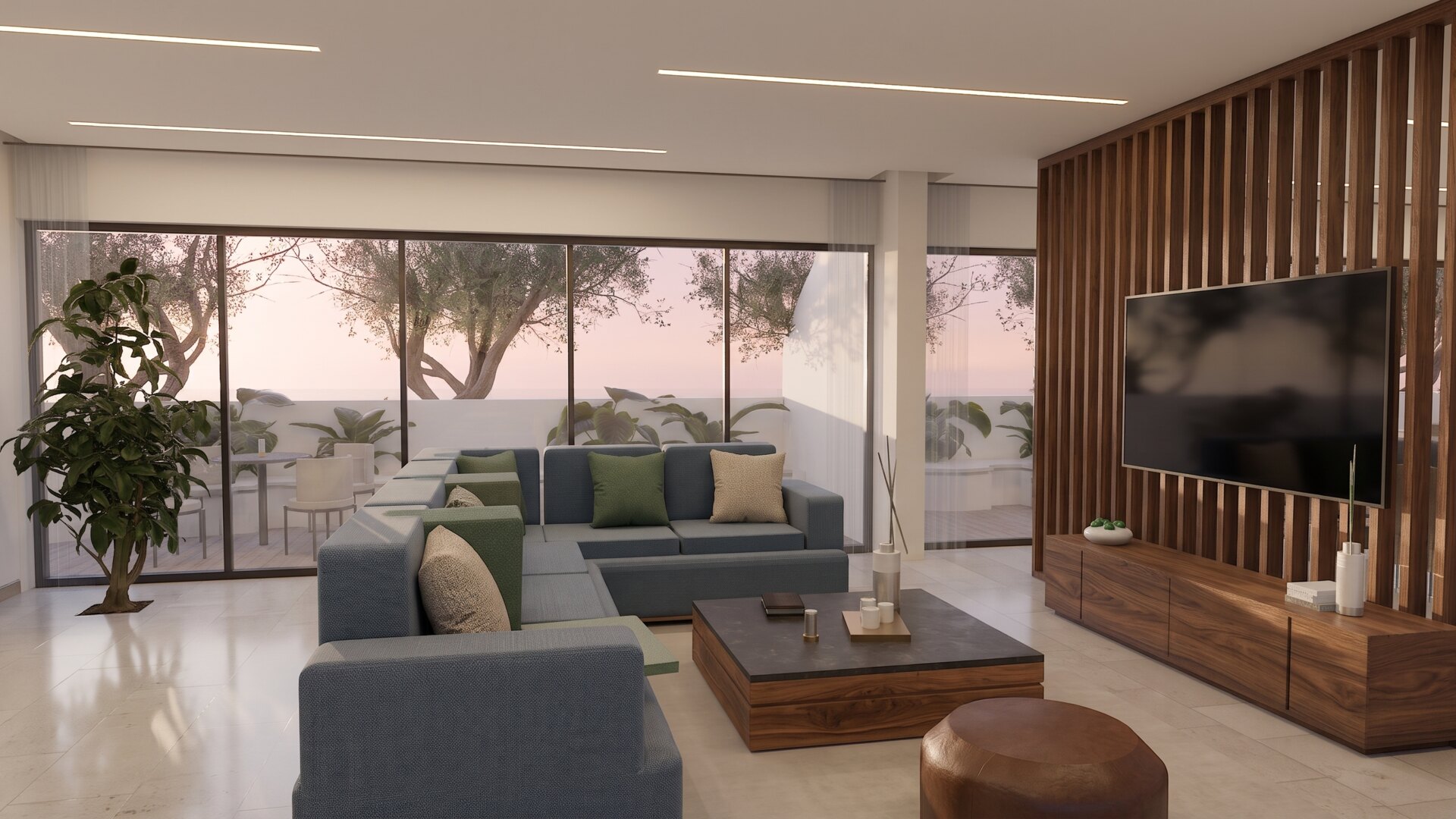
From an architect’s PDF to a photoreal walkthrough: up to 600 studio hours, done in two days
By hand, turning an architect’s PDF into a furnished, photoreal 3D walkthrough takes a small studio up to 600 hours. With AI it took two days for two floors, and each design change took minutes instead of one to three working days.
Tell us what you’re building.
A new project, a question about how we can help, or just curious about how we work.