




Aquatic Hideout
An aquarium business built and run by AI: about 2,480 hours of work in about 230
A price-comparison site, an Instagram channel, a fish studio, and an app in Goa, India, built and run by AI with one person making the calls. By hand the work would take about 2,480 hours; with AI it took about 230. Website users went from 34 to 1,426 a month, Instagram followers from 33 to 3,137, and an AI now supervises the studio’s shifts.
- By hand
- About 2,480 hours (estimate)
- With AI
- About 230 hours, Aug–Nov 2026
- Website
- 34 → 1,426 users a month
- 33 → 3,137 followers
Overview
About 2,480 hours of work, done in about 230.
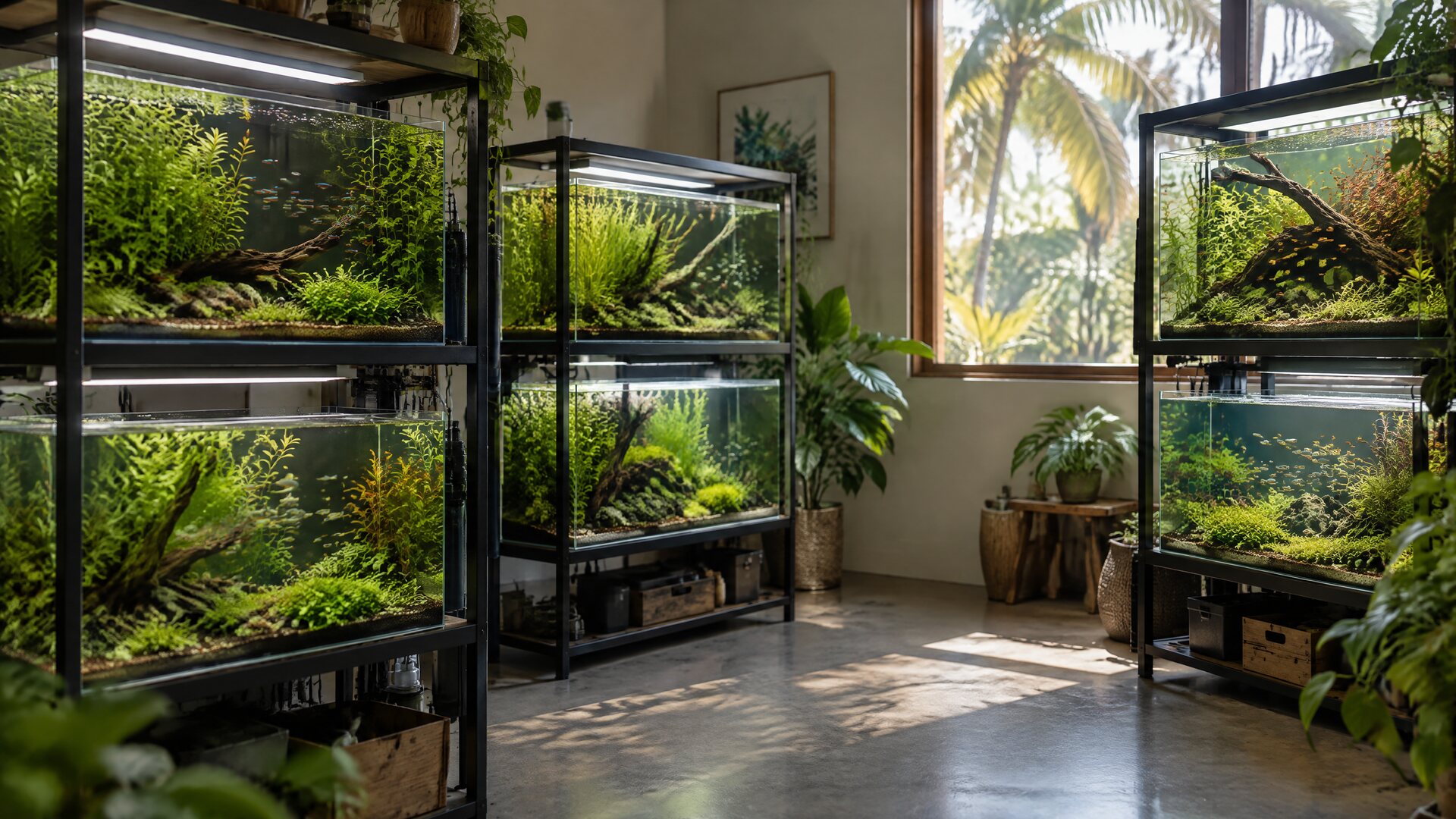
Aquatic Hideout is four things built and run with AI: a price-comparison site for aquarium fish, plants, and gear across India, an Instagram channel, a fish studio in Goa, and an app that runs its lights and equipment. One person makes the calls. Every number below is from the business’s own analytics, logs, and code.
August against November, from zero to regular visitors
26 August to 26 November, with reels made and posted by AI
an AI plans the shift, hands out every task, and checks the photo
across the fish studio, the office, and home tanks, in one place
Hours, by hand against with AIWhere 2,250 hours were saved
- By hand (our estimate)
- With AI
Website numbers are from Google Analytics, 1 August to 25 November. Instagram numbers are from Instagram Insights (to 12 October), Meta Business Suite, and the profile, read on 26 November. Studio numbers are from the shift log, 30 October to 26 November. App numbers are from its code. Pick a part below; each one starts with what changed, then shows how.
Part 1 · Chapter 01 · The website
From zero to 1,426 users a month
aquatichideout.com compares prices for aquarium fish, plants, and supplies from shops across India, and helps people plan a tank. It went public on 25 August with no visitors and no ad spend.
August against 1–25 November
people leaving to buy, August against November
read again twice a week, overnight, with nobody at the keyboard
by hand against with AI
Google Analytics · users a weekWebsite users a week, from launch
Google Analytics · sessions a month by sourceWhere the visitors come from
- Social media
- Search engines
- AI assistants
- Direct and other
Google Analytics · actions a monthPeople don’t just visit, they use it
- August
- November (1–25)
Part 1 · Chapter 02 · The data engine
Reading every aquarium shop in India, twice a week
The site is only as good as its prices. A pipeline written with AI reads each shop, cleans and matches the listings, holds back anything suspicious, and publishes. Since 24 November it runs on its own on Tuesday and Friday nights.
Shop stores, sitemaps, and page readers; a headless browser for the shops without a feed.
Every offer turned into one shape: name, price, stock, picture, link.
AI names each product so the same fish from five shops becomes one page.
A price that doubles or halves waits for a person; a missing listing is never called out of stock.
Price history, the live database, 14 test journeys, and a summary email.
Catalog files · products on the siteThe catalog, built in 15 weeks
Price runs · offers read per runTwelve price runs, 344,000 offers read
to check every offer by hand once, at 20 seconds an offer
Estimate
twice a week, overnight
Price job
Tools: Claude Code, Python, headless Chromium, Postgres, Railway, Cloudflare, Google Analytics
Part 1 · Chapter 03 · How it was built
One person, an AI, and 451 code changes
Claude Code wrote the site, the shop readers, the data clean-up, 1,141 tests, and the deploys; 440 of the 451 code changes were written with it. The owner decided what to build and checked it on his phone.
1–4 August
Shops read and merged into one catalog, India only.
13 August
A permanent address for every product, and pages search engines can read.
19 August
Database, hosting, analytics, and accounts with saved tanks, all on one day.
25 August
The site goes public.
September–November
Price alerts, shared baskets, a tank builder for six kinds of habitat, and a watch that emails the owner if price compare breaks.
for a small team to build the same site by hand
Estimate
with AI: 182 sittings, August to November
Git history
When something broke: on 14 November the database provider blocked the account for going over its data limit. The plan to move to a new database estimated 12–14 working days. AI planned and made the move in about 13 hours, and price compare kept working throughout.
for the database move, as the plan estimated it
Estimate
from plan to switch-over, 16–17 Nov
Worklog
Part 2 · Chapter 01 · Instagram
AI content on autopilot, and an audience that grew 95 times
Two reels a day, at 7:00 and 19:00 India time, go out on Instagram, YouTube Shorts, and Facebook. AI writes them, checks every price against the site, makes the pictures and the voice, edits, and posts. The owner gives a go for each batch.
26 August to 26 November
29 October to 25 November, against the 28 days before
3 August to 12 October
from social media, August against November
Instagram followersFollowers, from the first reels to today
Instagram Insights · views a weekReel views a week
Instagram Insights · a monthLikes, saves, and sends
- August
- September
Instagram Insights · top reelsThe five reels with the most views
Part 2 · Chapter 02 · The reels
The two that did best
Both were made by the same pipeline as every other reel. Sound on.
Part 2 · Chapter 03 · How a reel is made
Six steps from script to post
A finished reel takes about half an hour of machine time. By hand, writing, filming, recording, editing, and posting a short reel like these takes a small team about four hours.
Script
Claude writes 30–40 seconds of voiceover on one topic, such as ten plants that grow without CO2.
Price check
Every price in the script is checked against aquatichideout.com before anything else is made.
Pictures
Real footage first, then AI stills, then short AI video clips from Higgsfield for the opening shot.
Voice
One AI voiceover take, cut to the words.
Edit and cover
The video is built by script, with a cover checked against the Instagram grid.
Post
A queue posts to Instagram every few minutes when a reel is due; Facebook and YouTube are scheduled ahead.
HoursOne reel, and all 187
- By hand (our estimate)
- With AI (machine time)
Tools: Claude, Higgsfield, ElevenLabs, ffmpeg, Notion, Meta and YouTube schedulers
Part 3 · Chapter 01 · The fish studio
An AI supervisor for a one-person studio
The studio keeps the fish and plants. One assistant works there, Monday to Saturday, 8:30 to 17:30. Instead of a manager, an AI plans her day, hands her one task at a time, checks the photo she sends back, nudges when a job runs long, and only calls the owner when it matters.
a supervisor’s time for 23 shifts, at eight hours a shift
per shift, with a photo or a log line as proof
first two weeks against the third
after the fixes on 16–18 November
Time analysis · 16 full shiftsWhere a paid shift goes, in minutes
- Work with proof409 min
- Breaks41 min
- Waiting on the AI34 min
- Late start or early leave11 min
- Long lunch6 min
- Blocked by the internet2 min
Time analysis · jobs done per shiftMore done every week
Time analysis · minutes per shiftWork, breaks, and waiting, shift by shift
- Work with proof
- Breaks
- Waiting on the AI
Part 3 · Chapter 02 · How a shift runs
Clock in to clock out, one task at a time
The shift log records every message between the AI and the assistant: 2,531 events in 22 shifts.
one at a time, each with a time to beat
every finished task comes back with a picture
a reminder instead of a manager walking over
everything else the AI decided on its own
Clock in
The AI greets the shift and sends the first task with the time it should take.
Look and remove
Every tank is checked and anything that died is taken out.
Feed and count
One tank at a time, counted against the stock list.
Hardware check
Filters, air, heaters, and lights, one rack at a time.
Water round
A water change every day. A worrying photo triggers a water test within 30 minutes.
Time analysis · minutes per jobPlanned time against real time
- Time given
- Time it really took (median)
of a supervisor’s time for 23 shifts, at eight hours a shift
Estimate
planned and followed every shift, with the owner on call
Shift log
Part 3 · Chapter 03 · What went wrong
What broke, and the rule it left behind
A studio with living animals is not a place to pretend nothing goes wrong. Each problem became a rule.
Water before fish
After a nitrite spike in one tank, a worrying photo now triggers a water test within 30 minutes, and that tank got no new fish until it read clean two days running.
Waiting on the AI
The assistant lost about 34 minutes a day waiting for the next task, and the AI loop stalled twice. It now runs three checks before every message, with a watchdog every 15 minutes.
The lamps that wouldn’t light
On 11 November the app showed every light on, but the racks drew no power: the lamps’ own switches were off. New rule: lamp switches stay on, the sockets do the switching.
People decide
The owner decides anything that changes the water, every purchase, and any message to someone outside the team.
Part 4 · Chapter 01 · The app
One app for every light, fan, and filter
Before, every gadget had its own app: one for the Bluetooth tank lights, one for the smart plugs, one for the air conditioner’s remote, and wall switches for the rest. The AH app brings all of it into one place, with its own schedules and safety rules, and agents that can switch, check, and fix things through the same doors a person uses.
26 smart sockets and switches plus 2 Bluetooth lights
one schedule for all of them
plus a phone’s infrared remote app for the air conditioner
by hand against with AI
- Tanks, with a life-support alert
- The main tank and an algae blackout
- The light schedule: sunrise, daylight, sunset
- Devices and protected sockets
Part 4 · Chapter 02 · The board
A small chip that speaks Bluetooth and Wi-Fi
The tank lights at home only spoke Bluetooth to their own app. An ESP32 board, a small Wi-Fi and Bluetooth chip, now sits next to the tank and passes the app’s commands on, with its own clock so the light schedule keeps running if the internet drops.
The hardwareAn ESP32 board, programmed by AI
The ecosystemEverything the app reaches
Device list, 5 NovemberWhat the app switches, by place
- Home tanks and room14 switches
- Fish studio12 switches
- Home tank lights (Bluetooth)2 lights
- Office (infrared)2 remotes
Part 4 · Chapter 03 · Agentic by design
An app that agents can run
The app was built for an AI to operate as much as for a person. That is what lets the studio’s AI switch lights on schedule, and lets a Claude session fix a socket from a sentence.
Life support can’t be switched off
Filters, air pumps, heaters, and the controller are locked: no schedule, agent, or tap can turn them off by accident.
It checks its own work
After every switch the app reads the socket back and tries once more if it didn’t change, and logs it.
It recovers on its own
If one way of reaching the plugs fails, it switches to the other and says when it works again. After a power cut, the lights pick up their schedule.
Agents use the same doors
61 routes for plugs, tanks, schedules, remotes, and updates, so an AI agent can turn on lights, run a blackout against algae, or find a dead socket the way a person would.
Mapped in ten minutes
To find which socket runs which tank, the AI blinked each one for five seconds while the assistant watched: 11 blinks, ten minutes.
Gentle on limits
It checks the plugs every 30 minutes when nobody is looking and every two minutes while the app is open, to stay inside the free tier.
HoursBuilding the app
- By hand (our estimate)
- With AI
Tools: Claude Code, ESP32 (NodeMCU-32S), Bluetooth, Smart Life, infrared blaster, Node.js, Railway
The numbers
The hours, side by side
Everything on one table: our estimate of the hours by hand against what AI took.
| Work | By hand (estimate) | With AI | Source |
|---|---|---|---|
| Build the website | About 1,490 hours | About 116 hours | Git history |
| Move the database after an outage | 96–112 hours | About 13 hours | Worklog |
| Check every price once | About 300 hours | Unattended, twice a week | Price job |
| One reel | About 4 hours | About 30 minutes of machine time | Production log |
| 187 reels | About 748 hours | About 94 hours | Production log |
| Supervise 23 studio shifts | About 184 hours | AI, owner on call | Shift log |
| Build the app | About 240 hours | About 16 hours | Git history |
| Build the site, the reels, and the app | About 2,480 hours | About 230 hours |
Who decided
The owner decided
What to sell and stock, every batch of reels, anything that changes the water, every purchase, any message outside the team, and when to switch a socket live.
AI did
Wrote and deployed the site, kept 54,538 prices fresh, made and posted the reels, planned every shift, checked every photo, and switched the lights.
Lessons
What we would tell another business
Measure from day one
Analytics went in on 19 August, before the first visitor, so the climb from zero is on record.
Check facts against your own data
Every reel’s prices are checked against the site before the voice is made, so the content and the shop never disagree.
Build for agents
An app with clear doors for every action can be run by AI as easily as by a person.
Want results like these?
Tell us about your project. We’ll show you how we would approach it, and what it could deliver.

From an architect’s PDF to a photoreal walkthrough: up to 600 studio hours, done in two days
By hand, turning an architect’s PDF into a furnished, photoreal 3D walkthrough takes a small studio up to 600 hours. With AI it took two days for two floors, and each design change took minutes instead of one to three working days.

Fat Hamster: from a 2D logo to a rig-ready 3D mascot in one day
How Fat Hamster Studio’s 2023 logo became a textured, rig-ready 3D character and three short videos in about 17 hours, with AI in the loop and a person on every pick.
Tell us what you’re building.
A new project, a question about how we can help, or just curious about how we work.
Part 2 · Chapter 04 · Social to site
The reels fill the website
Social media is the site’s biggest source of visitors: 68% of its sessions in November. Every reel points to a price on the site, so a view turns into a visit.
Google Analytics · sessions a monthWebsite visits from social media
Engagement on autopilot too
From 8 August to 19 September an AI ran 41 Instagram rounds and ten YouTube rounds: a few comments, follows, and likes each time, spaced over 75–110 minutes on purpose, with a kill switch at the first sign of a limit.
What we learned
Questions beat statements: a title asking “help me pick a betta” got about eight times the views of a plain one. And lists beat tips. The work is judged by views, saves, and visits to the site, not by followers alone.